Thursday, August 31, 2006

Stripping For Public Education

Things are so bad in Las Vegas' public schools that even strip clubs are doing their part to support public education:
The Clark County School District kicked off the first day of school Wednesday with scant resources. But it got a major donation from the scantily clad.

The same day the nation's fifth largest school district began the year with some 400 teaching vacancies, the nonprofit corporation that supports it, the Public Education Foundation, accepted a $2,500 donation from a strip club, Scores Las Vegas.

"Thank you for your donation of $2,500, received on August 30, 2006," said a letter from foundation president Judi Steele to Scores' marketing director, Shai Cohen. "Thank you again for your willingness to support our community and invest in our children ... our future."

Scores raised the funds at an Aug. 23 back-to-school event called "Detention" that featured strippers dressed as teachers, schoolgirls and librarians.

"It's back to school time and you know what that means. Detention for everyone who has been bad!" one advertisement read.

The performers peeled off clothes and offered lap dances to customers, Cohen said. Patrons also left more than $1,000 donations in a jar that the club said would go to the Clark County School District. Scores matched the donations roughly dollar for dollar, he said.

"In this town, money is money, regardless," Cohen said. "We're a respectable business. We pay taxes like everybody else. We have a business license. It's for a good cause."

"Education is very important," he said.

The foundation's director of development, Deb Hegna, said the donation was gratefully accepted.

"From any licensed, legitimate business, we're certainly happy to accept donations," she said, adding the gentleman's club told them it had raised the funds at a charity event.

The money was earmarked for the foundation's exchange program, which provides new or gently used materials, supplies and computers to Clark County teachers for free or little cost.

The district, a sprawling area covering 8,000 square miles in southern Nevada with more than 300,000 students expected this year, is the fastest growing in the nation, said school district spokesman Steve Lombard.

The district has had difficulty hiring teachers to keep pace with growth, especially with the high cost of housing in southern Nevada, he said. The state ranks 46th in the nation in per-pupil spending, according to a U.S. Census Bureau report.

The district's associate superintendent, Karlene Lee, said the district was not informed about and did not condone the flier used to promote the strip event.

Lee had no comment on the fundraising activities of the foundation, a separate entity which raises about $5 million a year.

"The donation was made to the foundation and for the inner workings of how that functions, you can contact the foundation again."
When it comes to donations of cash, I guess beggers can't be choosers.

On the other hand, these developments put a whole new spin on possible offerings for "adult night school."


Related: For those who feel the need, the "Scores Las Vegas" website may be accessed from the WaPo article, (bottom of page 2) but it may not be (obviously) "work safe."
------------------------------
See our latest EduPosts.

Homework: The Mystery Behind The Myth

Joanne Jacobs:
"Homework Hooey" is the apt headline on Martin Davis' New York Post column critiquing two books -- Alfie Kohn's The Homework Myth and The Case against Homework by Sara Bennett and Nancy Kalish-- that argue American students are overworked, leading to depression, obesity, family tension, and, no doubt, acne. Homework doesn't help students learn, they argue. It just eats up time that could be devoted to emotional development, family conversations and fat-burning sports. (Or to playing computer games.)

In truth, a small minority of students are working quite hard -- in addition to a heavy load of extracurriculars -- while most spend little time on homework.
Read the Whole Thing.

Agree or disagree, a good read that's well worth your time.
----------------------------
See our latest EduPosts.

Ohio's School Of Mess

Students are jumping through the windows, the teachers are on strike, and the security guards have been fired for failing their background checks. Looks like a mess-in-progress:
PERKINS TOWNSHIP -- Teachers voted for no confidence in the administration, four students climbed out of high school windows and eight security guards were fired for failing background checks.

Yet the administration said schools were running as smoothly as possible in the second day of the Perkins Schools teachers' strike.

No new negotiation meetings as of last night were set for the teachers, administration and board members.

However, chants, signs and a lock-down greeted sophomores, juniors and seniors as they attended their first day of the school year at Perkins High School yesterday.

Operations ran smoothly, said Superintendent Sherry Buccieri, but students offered a different assessment.

The scene inside the high school was ''crazy,'' as ''chaos'' reigned while students watched television, talked on cellular telephones and played the card game Uno, according to several students.

About 19 students who had parental excuses left their high school classes around 12:15 p.m., prompting a lockdown at the school to ensure safety of students and staff, Buccieri said. While there were no immediate reports of threats or violence, the school followed the protocol so teachers could take attendance and account for students, she said.

Once the lockdown ended, police were posted at the high school doors, students said. About 2 p.m., at least four girls climbed out the first-floor window of an English classroom facing Campbell Street, where dozens of teachers marched next to the road.

''That was basically the only way out without being stopped,'' said Jessica Evans, who started her senior year in school and ended the day by climbing out the window.

''There was not other way to get out because they locked all the doors,'' said Beth Dahlmann, another senior who climbed out.

The students stood as a group with fellow seniors Laura Speer, Brittany Keegan, Keith Martinez and Melissa Frisch in the public right-of-way outside Perkins High School. Keegan, Speer and Martinez had parental excuses to leave school part-way through the day, while Frisch said she climbed out a window rather than stay inside.

Last year's first day of school was better organized, the group said.

''It's just not something you picture on the first day of school your senior year, or any year,'' Speer said.

It was unclear how many students who walked out also were children of striking teachers. Buccieri reported 10 students were, but the high school seniors said the number was five.

During the high school dismissal, teachers chanted: ''One, two, three, four, show Sherry to the door. Five, six, seven, eight, why won't she negotiate?'' Hand-written signs read ''Negotiate Now!'' ''Safe?'' and ''Support Perkins Teachers.''

In the parking lot, a red sport-utility vehicle blasted the '80s metal anthem ''We're Not Gonna Take It'' by Twisted Sister.

Perkins police guided traffic as cars and school buses backed up in a line at least a quarter-mile long in both lanes of Campbell Street. At least some of the cars honked their horns repeatedly as they passed by the school.

''It's nice to hear people beeping,'' Speer said.

''It's reassuring to hear people supporting,'' Martinez said.

Speaking about the activities in the high school, Buccieri said she would ''highly doubt'' that Principal Chris Gasteier and Assistant Principal Mark Dahlmann would tolerate students being unruly.

She said any student disciplinary actions, including those for students who leave without parental notes, would be left to building principals. Gasteier yesterday declined to speak to reporters, deferring instead to Buccieri and the school board.

The students leaving school was not considered a walkout because they had parents' permission to leave, Buccieri said.

''They were dismissed, and perhaps this was staged,'' she said.

Despite the tumult, over two days the high school's initial reports showed 10 of 570 students were absent from their respective first days of school. Freshmen started Monday, grades 10 to 12 yesterday and the four classes will be together today.

''I find this gratifying and a testament to the community's interest in their children receiving an education in challenging circumstances,'' Buccieri said.

Among the other schools, Buccieri reported yesterday's attendance as:

-- 59 absences of 527 enrolled at Briar Middle School, which has grades seven and eight.

-- 53 absences of 269 enrolled at Furry Elementary Schools, with grades kindergarten to two.

-- 84 absences of 509 enrolled at Meadowlawn Intermediate School, which has grades three, four and five.

Students at the high school received their handbooks, had their photos taken and reviewed homeroom procedures, Buccieri said. She added she toured Meadowlawn and Furry schools in the morning.

''There were lots of good, solid educational assessments being done,'' Buccieri said.

The district also reported 122 administrators, qualified substitute teachers and highly qualified educational aides were in the classrooms for the schools. That number was up from at least 75 Monday, and by the end of the week, Perkins could have a full slate of about 130 substitute teachers in its schools, Buccieri said.

As of yesterday, two teachers had crossed the line and returned to work at Briar Middle School and the high school, Buccieri said. She did not give a reason why they crossed the picket lines.

''We don't ask,'' Buccieri said. ''That's a personal decision and I respect their privacy.''

Before heading out for the picket lines, members of the Perkins Education Association voted unanimously for a vote of no confidence in Buccieri's ''ability to effectively lead the school district,'' according to a union statement.

''During the last several contract negotiations the PEA and the BOE were able to come to terms which benefited Perkins students, employees and the entire Perkins community,'' the PEA statement said. ''With Sherri Buccieri as the superintendent in Perkins chaos has been the order of the day. Our students and our community deserve better. Take back Perkins schools!''

At the schools, teachers also distributed handouts with ''Latest reports from parents and students entering Perkins Schools.''

Among the reports: ''Chaos and confusion,'' the flyer read. ''Up to 100 students in one room. Lack of communication to parents coming to school. Students assigned to rooms without desks or chairs. Students watching TV, some napping, some throwing spitballs.''

As for the lockdown, PEA Action Team spokesman Bob Myer deferred comment to the administration and board of education.

However, he questioned whether substitute teachers would be as familiar with school protocols as the PEA members.

''Are they trained on how to handle our crisis procedures?'' Myer said. ''That would be my concern, because what if it was a real crisis?''

About 6:36 p.m., the board of education and Buccieri sent out a statement vowing to continue the strike operations despite the dismissal of eight private security guards with ''unacceptable background checks.'' The announcement did not specify details about the guards' identities or why the background checks were unacceptable.

Perkins schools will keep 10 guards provided by Huffmaster and who have acceptable checks, for protection of school grounds at night and for transporting substitute teachers.

Perkins police, who already are providing daytime security, also will provide background checks on future guards employed by the schools through Huffmaster.

Buccieri emphasized she and the board hope to settle the strike as soon as possible.

Several students agreed.

''I think it's going to be really short or really long,'' said Katie Collins, a sophomore. ''I hope it's short.''

She stood outside after school with friends and fellow sophomores Natalie Sabo and Jill Bahnsen. The group said they would like to be on the picket lines with teachers but were attending school to participate in volleyball and cheerleading.

''If we didn't have sports, we'd be out here for sure,'' Sabo said.

''I just think the board and the teachers should agree on something,'' Bahnsen said. ''It can't be that hard to negotiate.''
I guess rather this is a mess or not depends on one's perspective.

Sadly, it'll be the students who pay the price because the grown-ups can't seem to act like adults
.
---------------------------
See our latest EduPosts.

Teaching Tips From The Trenches

With schools starting-up all over America, now might be a good time to take a look at some helpful tips from teachers "who've been in the trenches."

NYC Educator has
some sound common sense advice for both the novice and experienced educator.

Like him, I wish that someone had of told me...
------------------------------
See our latest EduPosts.

'Tis The Season For Student Walkouts?

The Washington Post is telling us that more protests on behalf of illegal immigrants are in the works:
After four months of relative quiet, immigration reform advocates are mobilizing a new round of protests in Washington and other cities to put pressure on a returning Congress and reinvigorate a Latino movement that awakened in massive demonstrations this spring.

The events will begin tomorrow in Chicago, where demonstrators plan to set out on a four-day march to the district offices of House Speaker J. Dennis Hastert (R) in Batavia, Ill., and will continue with one-day rallies throughout next week in Phoenix, Washington and Los Angeles.

In the Washington region, activists are distributing leaflets, and Spanish-language radio is buzzing about a Sept. 7 rally that organizers hope will be the biggest yet. Organizers say their goal is 1 million protesters from up and down the East Coast for a rally on the Mall and a march to the White House.

"We want to make sure that Congress and this administration get a very clear message that the immigrant community is still paying attention to what's happening in the immigration debate and that we know that it's election time," said Jaime Contreras, chairman of the National Capital Immigration Coalition, the rally's organizer.

Local organizers said they are improving on spring rallies that were hastily planned amid a spontaneous groundswell of activism. To avoid a backlash against foreign flags, they are directing all protesters to carry U.S. flags. They are starting the rally at 4 p.m. so student demonstrators, who frustrated school administrators by walking out earlier this year, can participate. And organizers have nearly tripled their budget for portable toilets.

In media interviews and on fliers, they have simplified their focus to key demands: legalization for the unauthorized and an end to stepped-up arrests of illegal immigrants.

"We are learning," said Juan Carlos Ruiz, general coordinator of the regional coalition.

The return to street protest, a tactic that galvanized millions this spring, comes after public discord among activists over a May 1 work boycott and a summer when their focus turned to immigrant voter registration drives. At the same time, new immigration legislation grew even more elusive in Congress, which is deadlocked on the issue.

Some believe it could be risky. The spring protests roused supporters but also stirred fierce hostility, said Steven A. Camarota of the Center for Immigration Studies, which favors lower levels of immigration. That kind of intensity might make members of Congress, which is approaching midterm elections, even less likely to touch the immigration issue.

"They want to energize the community . . . to put the issue on the agenda and make it clear that look, it's not going away," Camarota said. "By doing all that, they may also hurt the prospect of the legislation passing."

The immigrant movement is still developing. Regional coalitions are trying to figure out how to work together nationally, and no clear leader has emerged. Locally, the National Capital Immigration Coalition -- a network of about 60 organizations that has existed for four years -- is just now defining the qualifications for formal membership.

As for immigrant voter registration, national figures are not yet compiled, said Germonique R. Jones of the Center for Community Change in the District, but anecdotal evidence points to success in some areas. She said Phoenix organizers, for example, are en route to meeting a summer goal of registering 20,000 voters.

Local results have been tepid. Northern Virginia immigrant organizations had no drives. Groups in the District registered 200 voters, said Kim Propeack, advocacy director for CASA of Maryland. In Maryland, Korean organizations registered 350, while CASA of Maryland registered 425 and quadrupled enrollment in its citizenship workshops, Propeack said.

But organizers say the movement has not lost steam. Immigrants, they said, are enthusiastic about the coming protests, believing the demonstrations empower them and weaken support for an enforcement-only House proposal.

"If that's what we accomplished with marches, then let's keep marching," said Jorge Mujica, a rally organizer in Chicago.

Other observers are uncertain. Carlos Aragon, general manager of Radio Fiesta (1480 AM), a Woodbridge station that has been broadcasting information about the Sept. 7 rally, said the event is a hot topic among listeners -- but they now sound more cautious.

"Nothing happened in regard to immigration in Congress," Aragon said. "People are just not sure if it will help."

This week's Chicago march will be followed by protests Sept. 4 in Phoenix and Sept. 9 in Los Angeles.

Unlike previous rallies that drew people from the Washington region, the Sept. 7 event will include participants from along the East Coast. Organizers said at least 100 busloads of marchers will roll in.

To encourage local turnout, organizers are intensifying the strategies they used in the spring. They are playing radio promotional spots each hour on some Spanish-language stations. Volunteers are distributing fliers at churches, soccer fields, Metro stations and construction sites.

With the responsibility of having a demonstration for out-of-towners upon them, local leaders are striving to plan a smoother -- and savvier -- event.

On a recent night, organizer Edgar Rivera led a planning meeting at the Alexandria offices of Tenants and Workers United. He listed all that will be different about this march: After rallying, demonstrators will proceed to the White House for the first time, he said.

Organizers will dispatch Spanish-speaking volunteers to Metro stations to direct demonstrators, Rivera told those gathered. And more high-profile speakers will be included -- maybe Jesse L. Jackson and a Catholic cardinal, he said -- but fewer politicians.

"It's the community that should be out there," Rivera said.
For some reason, my "gut" instinct says that this time around there won't be the same type of massive student walkouts that occured last spring.

But I could be wrong.
--------------------------------
See our latest EduPosts right here.

Wednesday, August 30, 2006

Is Year-Round Schooling Coming To The Deep South?

Anyone who's spent a summer in the deep south develops a healthy dislike for humidity and an abiding respect for that technological marvel known as air conditioning.

And now a combination of explosive population growth and reluctance to raise taxes if forcing some districts in North Carolina to take
a hard look at year round schooling:
Wake County parents sounded off for the last time Monday on a plan to convert elementary schools to a year-round schedule.

At least 100 people crowded a public hearing at Southeast Raleigh High School to give the Board of Education their opinion.

“My name is Cindy Cincos. I represent a contingent of parents from Highcroft Drive Elementary opposed to mandatory year-round schools.”

One by one, Wake County parents made one last plea to the Board of Education.

“We ask that you please not convert A.B. Combs to a year-round calendar,” another parent said.

“Over 89 percent of our staff at Baucom has total opposition to forced conversion,” added another parent.

Supporters stood behind them in a show of solidarity. Those not at the podium let signs speak for them, all hoping the public hearing would make a difference in the school system's plan to convert nearly two dozen elementary schools to a year-round calendar.

"We've been to a lot of the meetings before and they listened to us so we want them to listen this time on the year-round issue,” said parent Carol Gehringer.

Administrators say they need to make room for 3000 students next school year and they believe year-round conversion is one of the best ways to do that.

But these parents don't buy it.

"Moving a current year-round student to another year-round school would only shuffle them from one school to another, not create additional seats,” said parent Matt Long.

Parents are clinging to the hope that their comments will convince the school board to change their plans.

Gehringer added, “We're just praying that they'll use some good sense and not look for the short-term answer."

Now the school board must decide exactly which schools will convert to a year-round calendar. They're scheduled to vote on the issue next week.
Our local high school district down here in California's "Imperial" Valley switched over to a year-round schedule, only to abandon it a few years later due to excessive absenteeism (we're in the desert) and the publicizing of the unpleasant fact that those with influence were able to get their children enrolled into a "traditional" track (There were 4 different "tracks," or schedules, called, "A," "B," "C," and "D.") that preserved the "traditional" summer vacation for them (It was track "C.") while the other three tracks attended year-round.
--------------------------
See today's edition of The Carnival of Education, hosted by Thespis Journal, here and our latest EduPosts there.

Declining SAT Scores: What Happened?

The New York Times has the awful news that SAT scores have had their biggest decline in decades:
The average score on the reading and math portions of the newly expanded SAT showed the largest decline in 31 years, according to a report released yesterday by the College Board on the performance of the high school class of 2006.

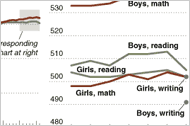
The drop confirmed earlier reports from puzzled college officials that they were seeing lower scores from applicants. The average score on the critical reading portion of the SAT, formerly known as the verbal test, fell 5 points, to 503, out of a maximum possible score of 800. The average math score fell 2 points, to 518. Together they amounted to the lowest combined score since 2002.

Officials of the College Board, the nonprofit organization that administers the SAT, dismissed suggestions by numerous high school guidance counselors that students were getting tired out by the new three-part test which now runs three and three-quarters hours, rather than three.

“Fatigue is not a factor,” Wayne Camara, vice president for research and analysis at the College Board said at a news conference. “We are not trying to say that students are not tired. But it is not affecting, on the whole, student performance.”

Instead, the officials attributed the drop to a decline in the number of students who took the exam more than once. The board said 47 percent of this year’s students took the test only once, up from 44 percent last year. The number taking the test three times fell to less than 13 percent from nearly 15 percent.

Students typically gain 14 points a section when they take the test a second time, and another 10 or 11 points a section on the third try.

The SAT writing test includes a 25-minute essay, which counts for about 30 percent of the writing score, and 49 multiple-choice questions on grammar and usage, which count for the rest. The average score on the writing section was 497 out of a possible 800, the board said.

Girls performed better than boys on this section of the exam, averaging 502 versus 491 for boys. That partly offset girls’ lower scores on math and reading, but did not close the longstanding score gap between boy and girls.

Gaston Caperton, the president of the College Board, pointed out that the decline in scores represented less than one-half of a test question in reading and one-fifth of one test question in math. Still it was the largest year to year decline since 1975, and officials expressed concerns about the overall performance of American students.

“The data does suggest that as a nation, critical reading and writing are lagging behind the progress we are making in math,” Mr. Camara said.

The SAT score decline contrasted with the increase in scores on the ACT exam, the other primary college admissions test. This month, ACT reported its biggest score increase in 20 years. The ACT also has a writing section, but it is optional.

Seppy Basili, senior vice president at Kaplan Inc., the education and test preparation company, said the new SAT test undoubtedly affected scores because students were less familiar with it and because fewer students repeated it. But Mr. Basili said he thought the length played a greater role than the College Board acknowledged.

“It is not just that the test is 3 hours and 45 minutes,” he said. “It is that the whole experience is five hours or more,” he said, factoring in things like breaks.

Most states, including New York, New Jersey and Connecticut, saw scores decline in reading and math. In New York, average reading scores fell 4 points to 493 and math scores 1 point to 510. In Connecticut, reading was down 5 points to 512 and math 1 point to 516. In New Jersey, reading fell 7 points to 496 and math 2 points to 515.

In New York City, Joel I. Klein, the chancellor of the education department, said, “My only reaction is, it shows that we have to continue to work harder.”

The number of students taking the SAT nationally fell slightly, by about 10,000 students, to just under 1.5 million, or about 48 percent of more than 3 million students who graduated from high school this year.

At a time when many elite colleges have expressed interest in recruiting more low-income students, the number of students from families earning $30,000 or less who took the SAT fell by more than 13 percent, to 183,317, while the number from families earning $100,000 or more rose 8 percent, to 225,869.

Mr. Camara said that of the information collected about students, the income data was the least reliable. He said he did not know what accounted for the decrease in low-income students taking the test.

Counselors in high schools where the SAT has long dominated, said more of their students were taking the ACT. Some have said that in the wake of the College Board’s disclosure this spring that it had mis-scored more than 5,000 exams, they have urged their students to consider the ACT.
To me, it's particularly troubling that fewer students from economically disadvantaged homes are taking the examination.

I want to see more of these kids graduating from top-tier schools. I think that it's healthier for our society.
--------------------------
See today's edition of The Carnival of Education, hosted by Thespis Journal, here and our latest EduPosts there.

Ivy League Menace

This guy not only needed to lose his professorship, but needs a severe beating to be locked up forever: (emphasis ours)
An Ivy League professor has been arrested for the third time in 11 years on child sex charges, in this case over video that allegedly shows him engaging in sex acts with boys.

Because of the charges, L. Scott Ward, a professor emeritus at the University of Pennsylvania's Wharton School of Business, was being stripped of his teaching assignments, spokeswoman Lori N. Doyle said Tuesday.

"We have made arrangements to ensure that he will not be teaching at the Wharton School or elsewhere at the University this semester and he will not teach at Penn in the future," Doyle said of the retired professor.

Ward, 63, was arrested Sunday after arriving at Washington's Dulles airport on a flight from Brazil, federal authorities said. He drew the attention of federal agents because of his unusual number of trips to Thailand, a destination for people seeking sex with minors, according to an affidavit released Monday.

Agents examined his laptop computer and found a video showing two children who looked to be as young as 8 engaged in sexual activity, authorities alleged in the affidavit. Agents also found video recordings of Ward involved in sex acts with boys who look to be about 14 to 16, the affidavit said.

Ward appeared in federal court Monday in Alexandria, Va., and was being held pending charges, Immigration and Customs Enforcement spokesman Dean Boyd said.

Ward's attorney, federal public defender Meghan Skelton, declined to comment Tuesday.

In 1995, a jury acquitted Ward of involuntary deviate sexual intercourse and deadlocked on other charges after his lawyer showed a videotape of the main witness appearing to try to extort a bribe from the defendant.

In 1999, Ward was accused of soliciting sex from a 23-year-old undercover state trooper posing as a 15-year-old boy. He entered an Alford plea, which means he pleaded guilty while not admitting he committed the crimes of attempting to promote prostitution and corrupt minors.

He said he was innocent but made the plea to avoid another trial. He was fined $2,500 and given five years of probation.
What really gets to me is that these preditors are usually guilty of numerous criminal acts for which they are never charged, convicted, or punished.
--------------------------
See today's edition of The Carnival of Education, hosted by Thespis Journal, here and our latest EduPosts there.

Carnival-O-Rama!

The 82nd midway of The Carnival of Education is open for your educational pleasure over at Thespis Journal. The theme this week is theatre and things theatrical. Don't miss the performance!
---------------------------
See our latest EduPosts.

Tuesday, August 29, 2006

Number 2 Becomes Number 1

Just when I think that I've seen it all in the EduWorld, I see Something Else.

Darren is giving us
the low-down about unisex bathrooms at an elementary school in Oakland, California.

I'm not even going to speculate on what such shenanigans would entail at the high school level.
-------------------------
See our latest EduPosts.

Striking In MoTown

Detroit's teachers went out on strike yesterday:
With teachers on the picket lines and Detroit Public Schools administrators asking Wayne County Circuit Court to force them back to the classrooms, a judge took a middle line Monday, ordering negotiators into a marathon, 24-hour session in hopes of breaking the impasse over a new contract.

And if that doesn't work by the time the session is scheduled to end at 6 tonight, both sides are to take an 8-hour break and then launch another full day of negotiations.

Whether Judge Susan Borman would then order the teachers back to school in time for next Tuesday's beginning of classes in the state's largest school district remains to be seen. But administrators say they have the law on their side: It's against the law for public employees to strike in Michigan.

Monday was supposed to be Detroit teachers' first day back at work, giving them a week to prepare for classes, but they voted Sunday to strike until a contract agreement is reached. They complained that the district wants them to take a mix of cuts in pay and benefits to make up $88 million of a projected $105-million budget deficit.

Only about 600 of the Detroit Federation of Teachers' 10,000 members reported to work Monday, according to the school district. Others picketed in front of schools.

Teachers carried signs bearing words such as "Stop Wasting the Money" and "Hands Off My Benefits," saying they refuse to go back to work until they see a contract that keeps their pay intact. The union has asked for a 3-year contract that would give teachers a 5% pay raise each year.

"I want fairness in the contract and a slight pay raise," said William Gardner, a fifth-grade teacher who picketed outside Malcolm X Academy's new site on West Chicago. "And I don't want to lose my benefits."

The order sending both sides back to the table came as Gov. Jennifer Granholm, Mayor Kwame Kilpatrick and school board members appealed to them to hunker down for around-the-clock bargaining to ensure classes start on time.

In Detroit, teachers with master's degrees who are at the top of the scale earn $70,046 a year, placing the district 68th out of 83 in the metro area, according to the union.

Meeting with the Free Press' editorial board Monday, union President Janna Garrison complained that the district has not sent negotiators to the table who can make decisions to curtail the budget in other ways to get the contract hammered out.

"We are basically sitting up there with attorneys," Garrison said, "not decision makers."

The judge ordered Superintendent William F. Coleman III to take part in the marathon talks.

Michigan law prohibits strikes by public employees, and teachers can be fined a day's pay for each day of the strike. But the union struck without being fined seven years ago, learning that the process to fine strikers is too cumbersome when 10,000 workers are involved.

About 7,000 union members are teachers and the rest are other school employees.
Read the whole thing.

My guess is that some sort of agreement will be hammered out in time for classes to begin next week.

But who knows for sure?
----------------------------
Entries for this week's Carnival of Education are due tonight. Get details here and see our latest EduPosts there.

Criminalities

Last evening, I went for a little walk just before bed time.

At about 10:15 PM, I came across three street punks teenaged boys who were "tagging vandalizing a homeowner's property by spray painting their idiotic (and senseless) "gang" symbols on the streetside privacy fence. (Which faces a major thoroughfare here in our town.)

Before I could get too close, the little thugs saw me approaching and ran to Parts Unknown. (If only I had brought a cell phone!)

While it is true that these teenaged hooligans were committing a crime against some innocent homeowners' property, (The vandals have repeatedly struck this fence, which runs about 1/2 mile. Gamely, the property owners have been trying to cover the damage a quickly as they can.) I think that the greater crime was committed by the parents of these little delinquents.

For crime is what it is when "parents" allow their children to run amok go "out" so late on a school night.

Curiously, the school (and the school alone) is
held accountable even for those children's academic progress, even when they're out committing property crimes instead of doing their homework and getting a good night's sleep so that they'll be rested for school.
----------------------------
Entries for this week's Carnival of Education are due tonight. Get details here and see our latest EduPosts there.

Carnival Of Education Entries Are Due!

Entries for the 82nd midway of The Carnival Of Education (hosted this week by Thespis Journal) are due TODAY. Please email them to: thespis148 [at] gmail [dot] com . (Or use this handy submission form.) Submissions should be received no later than 8:00 PM (Eastern), 5:00 PM (Pacific). Contributions should include your site's name, the title of the post, and the post's URL if possible. View last week's edition, here and the Carnival's archives over there.

Barring unforeseen circumstances, the exhibits should open Wednesday.
------------------------------
See our latest education-related entries right here.

The Watcher's Council Has Spoken!

Each and every week, Watcher of Weasels sponsors a contest among posts from the Conservative side of the 'Sphere. The winning entries are determined by a jury of 12 writers (and The Watcher) known as "The Watchers Council."

The Council has met and cast their ballots for last week's submitted posts.

Council Member Entries: Right Wing Nut House took first place honors with Iraq: Quit or Commit.

Non-Council Entries: 3AM Magazine garnered the most votes with Bad Faith.


Get instructions for submitting a post (from your own site) to this week's competition right here.
------------------------
See our latest EduPosts.

Monday, August 28, 2006

Fun With Statistics: Mysterious Money

The National Center for Education Statistics is telling us that the total current expenditures in public and secondary were $8310.00 per student. (As of 2003-2004)

If we take a hypothetical class of 25 fourth-graders and multiply by $8310.00 each, we get a figure of.... $207,750.

Where does all that money go?


I know that the lion's share certainly isn't going into your local classroom teacher's pocket...

Consider going over to the NCES website and reading
the whole thing.
-----------------------------
See our latest EduPosts.

To The Inferno!

Over at Ms. Cornelius' place, they are offering a special tour of the "nine circles of high school hell."

Even though I think that I'm perpetually imprisioned (with the other doomed staff heretics) on Circle VI, it's the administrative types who lurk in Circle VIII that are the most frightening to me.

This tour of The Inferno shouldn't be missed. Visit by clicking here.
-----------------------------
See our latest EduPosts.

Students Swearing In Class: Tolerating The Intolerable?

During a professional development workshop in Victorville, California, the presenter urged teachers to not get upset when their students use foul language in the classroom: (emphasis ours)
Victor Valley Union High School District teachers have been coached on a new approach to disciplining students that has some teachers shaking their heads in disbelief.

One teacher has stepped forward to air her concerns publicly, although she said she is concerned about how doing so could affect her job security.

“There is a cultural war going on and evidently it is going on right at this school site,” said Julie Behrse, an art teacher at Maverick High School. “It really is a movement, and now it has a name,” she added, referring to what Speaker Ray Culberson called the “new professionalism.”

At issue is whether teachers need to adjust how they interact with and discipline students who misbehave, particularly students from difficult backgrounds.

Culberson, director of youth services for the San Bernardino City Unified School District, said at a back-to-school inservice meeting that students today have less respect for authority than they did when many teachers were in school and consequently, some teachers have unrealistic expectations of their students.

According to Culberson, many teenagers come to school with baggage from problems at home or other areas of their lives. Culberson described these students, who are prone to disruptive behavior, as “kids in chaos.”

The district superintendent, Julian Weaver, said Culberson’s message does not represent a change in district disciplinary policy, but Victor Valley has many students from chaotic backgrounds such as Culberson described, and teachers need to learn to interpret their students’ body language. When a student is visibly agitated, the teacher might not want to push any buttons by asking if he or she brought in homework that day.

“We need to see ourselves as teachers and adults in the classroom,” Weaver said, “but we shouldn’t see ourselves as dictators, where students see themselves as far less than the teacher.”

A teacher at Silverado High School, who asked to remain anonymous to protect her job, said she understood Culberson’s message to be that teachers need to do everything possible to reach students and keep them in school.

When Culberson asked the audience how many times they could tolerate hearing “f-— you” from a student and said he could personally handle more than 100 instances a day, the teacher said she felt the presentation became a bit “off the wall.” A teacher next to her told her that she would not tolerate one case of swearing.

Teachers should never take anything a student says personally, Culberson said. He referred to a teacher’s personal “f-— youmeter, meaning the number of times a teenager swears at them before they would discipline the student. If teachers have a low tolerance for bad behavior and frequently send a student out of the classroom, the students will drive them crazy whereas teachers with a high tolerance will be able to calmly follow school procedure and still discipline the student, Culberson said in an interview. Maverick High School principal Beth Crane declined to comment on Culberson’s speech, but principal Tracy Marsh of Silverado High School said state law prohibits vulgarity and swearing in the classroom and allows discipline ranging from suspension to being expelled, no matter what background a student comes from.

“Nothing a person from San Bernardino says can change state law,” Marsh said. “We do want to make sure that the example is set and the tone it set,” he said, referring to student behavior.

He added that although he did not attend the inservice, he spoke to four teachers at Silverado High School who heard the presentation and described it as a positive experience.

According to Weaver, Culberson received a standing ovation.

“Everything that I do is designed for the mental health of the teacher,” Culberson said, and added that he gives presentations free of charge.
I'm curious to know if teachers can be disciplined for swearing in the presence of an in-service speaker who has wasted several hours of time that could've been better spent preparing their classrooms for the first day of school?

I'm not sure that there's a "f--- you meter" big enough to measure the intensity...
-----------------------------
See our latest EduPosts.

When Teachers Strike: Thoughts And Ideas Welcomed

Last Saturday, we linked to a couple of current stories about teachers who are either about to, or already on, strike. We also asked our readers' opinions concerning this question:
When teachers and their employers are at loggerheads over salaries and working conditions, should they be able to strike, thereby closing the schools?
We've been enjoying the dialogues among the commenters and hope that you will consider sharing your thoughts there. (scroll down)
--------------------------------
See our latest EduPosts.

Bumper Crop

In terms of both numbers and diversity, more kids than ever before are enrolled in America's public schools writes Sam Dillon of The New York Times:
Some 55 million youngsters are enrolling for classes in the nation’s schools this fall, making this the largest group of students in America’s history and, in ethnic terms, the most dazzlingly diverse since waves of European immigrants washed through the public schools a century ago.

Millions of baby boomers and foreign-born parents are enrolling their children, sending a demographic bulge through the schools that is driving a surge in classroom construction.

It is also causing thousands of districts to hire additional qualified teachers at a time when the Bush administration is trying to increase teacher qualifications across the board. Many school systems have begun recruiting overseas for instructors in hard-to-staff subjects like special education and advanced math.

The rising enrollments are most obvious in districts like this one west of Washington, in Loudoun County, one of the nation’s fastest-growing school systems.

Thousands of government, technology and construction workers, many of them Hispanic, Asian and African-American, are streaming into new subdivisions within commuting distance of the Pentagon and the headquarters of America Online. They are transforming a school system that was once small and overwhelmingly white into one that is sprawling and increasingly cosmopolitan.

The Loudoun County Public Schools, where annual pay for starting teachers is $40,986, has hired almost all the 650 new teachers it needs to fill its classrooms when school begins on Sept. 5, scores of them through agencies that recruit teachers in foreign countries, the superintendent, Edgar B. Hatrick, said.

But some rapidly growing districts across the nation are having trouble. The Clark County School District in Las Vegas, for instance, where teachers’ starting salary is $33,000, has hired 2,000 teachers. But with classes scheduled to start Wednesday, the district was still looking for 400 others, mostly to teach special education and math, said Pat Nelson, a spokeswoman.

Most districts eventually find the teachers they need, but in extreme cases, some increase class sizes or call on substitutes until they hire a permanent teacher.

In projections published last year, the federal Department of Education said the nation’s elementary and secondary enrollments would grow, on average, by about 200,000 students annually, reaching 56.7 million in 2014. Demographers say the current bulge moving through the nation’s school systems owes to the children of the baby boom generation, which lasted from about 1946 to 1964, as well as to the children of immigrants. The enrollment trends would be uneven, regionally, with schools in the Northeast and Midwest losing students, on average, and those in the South and West growing, the department said.
There's much more to read in the whole thing.

I wonder where they are going to get the thousands of "highly qualified" teachers that they're going to need in order to serve all those kids?
--------------------------------
See our latest EduPosts.

Sunday, August 27, 2006

School Daze

Around our campus, we've had a week of "professional" development and classroom preparation time.

Tomorrow is the first day of classes at our junior high school here in California's "Imperial" Valley.

This evening, on the last day before le deluge, I feel much the same way a major-league baseball fan must feel at the end of spring training and before the first pitch is thrown on opening day.

When All Things are possible.

I'm looking forward to meeting my students!
---------------------------
See our latest EduPosts.

The Good 'Ole Days Necessarily Weren't So Good

And to think that Blackboard Jungle was released way back in 1955! (Whenever I have a really looong day in the classroom, I just remember that I can't have it as bad as the movie's main character, Mr. Dadier.)

The media's interest obsession with the concept of the out-of-control public school has been around for a very long time.

Trivia: Do you know the name of this movie's very famous theme song? Not only did it catapult the singers to number 1, but it launched (and gave its name to) an era.

Answer
here.
---------------------------------
See our latest EduPosts.

Flag Flapped In Colorado

Seventh grade history teacher Eric Hamlin put up some foreign flags in his classroom and ran right into a buzz saw:
Carmody Middle School geography teacher Eric Hamlin will be reassigned to another school, at his request, following a dispute over foreign flags in his classroom, Jefferson County school officials said Friday.

Hamlin has decided that his presence at Carmody would be divisive, the district said.

Hamlin, who taught seventh grade at the Lakewood school, was suspended with pay Wednesday after he refused to take down three foreign flags that he had hung in his room. The principal believed that Hamlin was in violation of a Colorado law barring the display of foreign flags in state buildings.

School district officials concluded that Hamlin's display fell under an educational exception to the state foreign flag law. But Hamlin had hinted Thursday that he might not feel welcome at Carmody because some workers there resented the media attention he brought to the school.

Hamlin had been with the district for nine years, but was on his first day of a new assignment at Carmody when the flag issue arose. Hamlin could not be reached for comment Friday.

A statement by the district quoted him as saying, "I want to do what's in the best interest of the Carmody family which includes the students and my fellow teachers. It is my hope that Carmody will move forward towards a successful school year, and put this incident behind them."

The district will seek another assignment for Hamlin. Meanwhile, he remains on paid leave.

Jefferson County school district spokeswoman Lynn Setzer said a new assignment for Hamlin could open within a few days as administrators determine where more teachers are needed for the new semester.

The flap started when Carmody Principal John Schalk determined that Hamlin was violating the law. Schalk is not being reprimanded, Setzer said.
Call me old fashioned, but when the boss directs an employee to do something that is not illegal, shouldn't the employee comply?

Here in our part of California, a teacher may be suspended immediately (pending termination of employment) for insubordination for "refusing" to comply with his or her principal's legal directives.

As for the flags themselves, (Hamlin has displayed some 60 over the years.) I don't have a problem with their display. After all, Hamlin is a history teacher, and colorful flags displayed tastefully in the classroom are good attention-grabbers and classroom discussion starters.

Still... I have to ask some questions: Was teacher Eric Hamlin insubordinate? And if he was, did he "get away" with it? And if he did "get away" with it, why? (See related story below.)

Related: See the Denver Post's columnist Jim Spencer's
take on this story (Spencer infers that Hamlin played the "race" card as one of the flags was that of Mexico.) and the Rocky Mountain News' follow-up.

Update:(PM) Check out the lively discussion in our commenting thread. We also give our opinion about what Hamlin should have done.
------------------------------
See our latest EduPosts.

Book'em Polski!

California history teacher Polski3 just threw away an Ebay's worth of slightly used history books!

Now why didn't I think of that last time we threw ours away?

Update: Spunkyhomeschool has the low-down on selling used textbooks on Ebay. It seems as though it's a little more complicated than one might think.
-------------------------------
See our latest EduPosts.

Saturday, August 26, 2006

The Spellings Report: Giving Credit Where It's Due

Globe-trotting U.S. Education Secretary Margaret Spellings has taken yet another trip, (our coverage of her earlier junkets travels here) this time to the opening of the Davidson Academy for gifted students. (The campus is located on the grounds of The University of Nevada in Reno. See their website here.) In her speech, she uttered the usual platitudes about NCLB and the need for educators to be held accountable for student progress.

But this time around, I came across something unexpected. Something that made us smile.

For the first time that I'm aware of, (and we monitor the Secretary's comings and goings regularly) The Queen of All Testing directed
some of her remarks at students and the need for them to take school more seriously:
This year I've traveled to India, Egypt and Russia, and I can tell you there is a hunger for education in those places that is often lacking in American students. Students work harder and longer, and they don't make or accept excuses—and neither do their cultures. These are the kids our kids are going to be competing against—and if we don't challenge them now—then we aren't doing our job to prepare them for the future.

Today, 90 percent of the fastest-growing jobs require postsecondary education. But a report released just last week showed almost 4 out of 5 high school graduates were unprepared for college-level work.

That's unacceptable.

All over our country, parents, students, policymakers, and educators are demanding more rigorous coursework. A recent survey showed a vast majority of adults believe our schools aren't adequately preparing students to compete in the global economy.

And the students agree—3 out of 4 high school students said they don't feel challenged.

A Gates Foundation study showed the lack of challenging coursework is one of the top reasons students drop out of high school. Many left school because their classes were boring and not relevant to their lives—not because they weren't passing, and certainly not because they didn't have the ability to succeed. In fact, it's estimated that 1 out of every 5 dropouts could qualify as gifted.

By denying children access to rigorous classes, we waste their potential, and we deny them the opportunity to improve their lives as well as ours.

We must challenge our students and create a system that demands they step up to the plate—and to do so, we must challenge ourselves.

We know the solution: raised expectations, higher standards, and rigorous coursework for every student, not just a few. Taking just one AP class can increase a child's ability to succeed—but unfortunately, nearly half our high schools currently offer no AP classes at all.

That's an opportunity gap we can't afford to tolerate, and I know Senator Ensign agrees. I appreciate everything he's doing to promote Congressional action around these issues.
I realize that it wasn't much, and she did talk mostly about students in other countries, but it is a start.

I agree with the Secretary's remarks that we need, "Rigorous coursework for every student, not just a few." But unless students step-up and give their best effort to learn the material, (and in the real world all-too-many students are focused on everything but academics) achieving the goals and objectives of The No Child Left Behind Act will remain an unfulfilled dream.

Now if only Margaret Spellings would finally say something about the need for America's parents to see that their kids had completed their homework, got a good night's rest, and arrived at school on time prepared to learn, I would do handsprings in front of my history class.
---------------------------
See our latest EduPosts.

Is More P.E. NOT A Go-Go For Fitter Kids?

For all of us who thought that more physical education would help make our kids slimmer and fitter, Joanne Jacobs has some bad news.

Here in California's "Imperial" Valley, many elementary school students get little, if any, physical education instruction. (Which is in direct violation of the state's education code.)

I wonder how much of that has to do with the fact that none of the elementary school campuses has a gymnasium even though outside temperatures in the spring and fall often exceed 110 degrees.
----------------------------
See our latest education-related entries.

The Question Of The Day: When Teachers Strike

It looks as though teachers in the Detroit public school system may soon be going out on strike and have already struck and closed the schools in Gary, Indiana.

So here's the question:
When teachers and their employers are at loggerheads over salaries and working conditions, should they be able to strike, thereby closing the schools?
Here in California, teachers may legally strike if they first go through several steps in the collective bargaining process.
-------------------------------
See our latest education-related entries right here.

Friday, August 25, 2006

The Long And The Pluto Of It...

Science teachers need not fear the expulsion of Pluto from the exclusive Celestial Planets Club. To the contrary, reports CNN:
Science teachers consider Pluto's flunking out of planet status a plus rather than a minus.

"It's exciting. It's a chance to teach kids that this is the nature of science. Things are always changing," said Rich Hogen, who taught fourth grade for 32 years in the Arizona school system.

At the beginning of the week, it looked as if Pluto would be spared the subtraction as the International Astronomical Union considered increasing the number of planets to 12.

But Thursday's vote reversed course, categorizing Pluto and two of the planet hopefuls, Ceres and Xena, as dwarf planets.

"I think it would have been more difficult had they added more," Hogen said. "There's a lot of research out there on the nine planets. They just dropped one."

Instructors who taught for years that our solar system has nine planets will have to spend some time brushing up on the new categories.

"I spent a half-hour poking around in books to get a sense of what definition of a planet has been used in the past and how the proposed changes are taking place," said John Whitsett, who has taught chemistry and physics for more than 30 years.

"It's a chance to start looking at more than just the nine planets," Whitsett said. "What do we mean by a comet? What do we mean by a dwarf planet?"

Whitsett believes the change will focus attention back on science, which he thinks has been relegated to a supporting role in recent years.

"Ever since No Child Left Behind was passed, there's been a tremendous emphasis on reading and math, and as a result, especially in elementary schools, science has taken a back seat," he said.

"What we have is something that's been making a lot of press. Students are going to be asking questions, and I've always found that the best time to teach is when kids are asking questions, " Whitsett said. "Anything that gets kids engaged and thinking about science has got to be a good thing."

Susan Wagner, vice president for exhibits and programs at Adler Planetarium in Chicago, Illinois, said her team has some work to do.

"We will definitely be adjusting our exhibits to reflect this vote," she said. "When our building was created, we originally had eight planets that were placed in the outside façade, because Pluto was not discovered. So it's ironic that we're going back to the eight planets."

Becky Peltonen, an elementary school teacher in Panama City, Florida, had mixed feelings.

"On one hand, I like for the eight to have exclusivity, because you need to have certain characteristics to be a planet. It shows kids that some things do have to change. We need to teach modern science and use the new definitions," Peltonen said.

"But on the other hand, I'd like to stick with tradition," she said. "Let Pluto be grandfathered in."

Peltonen was disappointed about the astronomical union's about-face on numbers. "I wanted them to add the planets, because I think that would inspire the next generation of explorers that there are things out there to be discovered."

Peltonen, who teaches science to all grades at Oscar Patterson Elementary School, had her fifth-graders sing their mnenomic "planets song" after the news of Pluto's downgrade.

"I'm going to have to write a new song!" she said when they finished.

A top science teacher pointed out another change. "Teachers will have to redo their murals," Gerry Wheeler, executive director of the National Science Teachers Association, said.

But, he said, "The opportunity far outweighs the inconveniences of renaming a planet."

Whitsett, who is the president-elect of the NSTA, emphasized that the refigured solar system can energize teaching the true meaning of science.

"It's not a collection of facts. It's a process. It's a way of solving problems. As our understanding of these facts changes, then the science changes a little bit," he said.

Science and understanding change, but this change is not so earth-shattering, he said.

"The solar system right now is exactly like it was 24 hours ago," Whitsett pointed out. "Nothing's changed in that time period -- just the name by which we define each of these things."
It may not be a planet, but a Pluto by any other name is just as far from the sun and just as cold.
-----------------------------
See our latest EduPosts.

New Orleans' Public Schools: One Year After Katrina

Schools are reopening all over the country. And that includes those in New Orleans one year after the devastation wrought by Hurricane Katrina:
As survivors go, Julia Felix may be small, but those third-grade pigtails are as long as the tales she has to tell.

Like so many displaced students, Julia spent a year as one of Katrina's vagabonds, CBS News correspondent Lee Cowan reports. "I've been first to Mississippi, then Atlanta, then Mississippi again, then here," Julia says.

And it hasn't been easy. "I have to keep switching friends," she says, "and then you never see them again, and then you maybe see them again. But you never know."

But this week, that all changed.

It's back-to-school in the Big Easy, and any reunion is a good one.

More than 50 schools — some in the hardest-hit areas — are scheduled to re-open by the end of the month. That's only half the number of schools that existed before the storm, but it's more than many thought possible just a year ago.

Floodwaters ravaged nearly a third of all the classrooms in New Orleans beyond repair. Some haven't changed much since the day the levees broke. But given that New Orleans had one of the worst public school systems in the country, Katrina may actually do some good.

"This is an unprecedented opportunity to rebuild the school system the way it should be," says Scott Cowan, president of Tulane University.

Cowan helped lead the charge for change, encouraging the state to take control away from the failing New Orleans school district and hand over an unprecedented 60 percent of the public schools to private companies.

They will be managed as charter schools — publicly funded but independently run.

"We can make faster decisions, we can make decisions that are more consistent with the needs of our kids than we ever were before," Cowan says.

Still, the challenges are daunting. Registration has been chaotic and confusing. Some schools are nowhere near ready. Teachers still have to be hired, and critics worry that many charter companies may not have the experience to handle the task alone.

But Julia, whose charter school opened on schedule, says Katrina taught her something that all of New Orleans should take to heart.

"I learned that sometimes you have to take a hard road, but you know that it is going to get all right," Julia says. "You never know when it's going to get all right, but it is." Watch video

She says she is now on the medium road, but the hard road will be OK eventually. Given where her road started, medium isn't too bad.
In pre-Katrina New Orleans, few of the affluent or upper middle-class sent their children to public schools, which were notorious for their crime, violence, and underachievement.

After speaking with relatives of ours who live in the New Orleans area, I don't think that's likely to change in the foreseeable future as those who have the financial means continue to re-enroll their offspring in private and parochial institutions.

And as long those folks with plenty of cash continue to "opt-out" of their own school system, I'm not optimistic that positive systemic change will occur in New Orleans' public schools.
------------------------
See our latest EduPosts.

Parental Wisdom Makes The Local Paper!

We live in California's "Imperial" Valley. This is a rather backward agricultural area in which the economic scene is dominated by a number of large "farms" of several thousand acres that are owned by a few very wealthy absentee owners, who (mostly) live "over the hill" in the much more temperate coastal areas in and around San Diego.

However, the actual farm work is done by immigrants, both legal and illegal.

Local governmental corruption is rampant, (and obvious to all) with nepotism and cronyism being factors in many hiring decisions at all governmental levels, including public education.

"Imperial" County is the poorest county in California and has the highest unemployment.

Not surprisingly, a large majority of "Imperial" County's students are from economically disadvantaged households where there are few parents with high school diplomas or college degrees.

Nevertheless, most parents in the "Imperial" Valley generally support public education and want (naturally) the best for their children but are rarely, if ever, actively involved in their children's schools or the local political scene.

So it came as a pleasant surprise when this letter written by a parent
appeared Monday in The Imperial Valley Press, (also absentee owned) which is what-passes-for-the-local-newspaper:
The school doors will soon be open, and your child will get inside. But the real question is, “Will they get out? Will they be left behind? Will this year again end in some form of disappointment?” The High School Exit Exam is in full force, and many parents and students are waking up to the alarm clock of accountability. Unfortunately, many will once again push the snooze button.

Just a couple of hints: If your child didn’t meet up to your expectations at the end of last year, or they had less than 2.0 with at least one F, please consider yourself warned. The red lights on your educational dash are blinking, but will anyone make it to the garage before something else goes awry? Young people who do not experience school success are more at risk for substance abuse or heading down a variety of other wrong paths.

Future concerned parents are proactive. When school starts, they are taking away TV, cell phones, freedom with friends and sports, in order to jump start the hearts of the academically comatose. If you take away distractions, you are likely to get more focus, which translates to work. If you give your child a very clear statement that the past was unacceptable, and they are now to experience consequences, you will be a better parent, and at risk for making them a better person.

The reality is that many students need help. There are many after school tutoring programs, and excellent teachers willing to invest time and extra attention before school, during lunch and after school for your child’s benefit. Take advantage of the grace that is offered. For families, less fiscally challenged, there are programs like Sylvan and private educational centers, who have committed staff with realistic solutions to your children’s learning woes.

There are many folks willing to help students, but the parent is the most powerful person in the equation. Parent power can get your child moving in the right direction and with the necessary support, success is achievable. Please act today. No educator really enjoys it when a child flunks or doesn’t graduate, unless maybe that is exactly what the student and the parent deserve.

JIM SHINN

El Centro
With the new school year just getting started in most areas of the country, I think that Mr. Shinn has put into written form what is on the minds of a great number of public school educators about now.

A successful public education system depends on teamwork involving educators, students, and parents.
-------------------------
See our latest EduPosts.

Thursday, August 24, 2006

The Knucklehead Of The Day: Bus Driver Delores Davis

Today's Knucklehead must surely be the Coushatta, Louisiana school bus driver who made black students sit in the back of the bus while reserving front seats for whites:
Nine black children attending Red River Elementary School were directed last week to the back of the school bus by a white driver who designated the front seats for white children.

The situation has outraged relatives of the black children who have filed a complaint with school officials.

Superintendent Kay Easley will meet with the family members in her office this morning.

The National Association for the Advancement of Colored People also is considering filing a formal charge with the U.S. Department of Justice. NAACP District Vice President James Panell, of Shreveport, said he would apprise Justice attorneys of the situation this week. He's considering asking for an investigation into the bus incident and other aspects of the school system's operations, including pupil-teacher ratio as it relates to the numbers of white and black children, along with a breakdown of the numbers of black and white teachers employed.

"If the smoke is there, then there's probably fire somewhere else," Panell said in a phone interview from New Orleans. "At this point, it is extremely alarming. We fought that battle 50 years ago, and we won. Why is this happening again?"

Easley would not comment much on the allegations Wednesday, saying it is a personnel issue. She acknowledged that she has investigated the claim. And she confirmed that the bus driver did not run her route Wednesday, nor would she today.

Asked if the driver would work for the rest of the year, Easley said, "I'm not going to answer the questions. "» You're getting all that you're going to get from me. I'm sorry."

Red River Elementary School Principal Jamie Lawrence tried to rectify the seating situation when it was brought to her attention. But it was ultimately handled at the Central Office, Patricia Sessoms said.

Sessoms aunt, Iva Richmond, is the mother of two of the children, ages 14 and 15, and foster parent to three others, ages 5, 6 and 10. Janice Williams, who is the mother of the other four children, is Richmond's neighbor. All nine children catch the bus at a stop on Ashland Road.

Sessoms will join Richmond and Williams in their meeting with Easley today. Sessoms said they would ask for bus driver Delores Davis' immediate termination. Davis, who originates her bus route in Martin, has called Richmond to apologize, Sessoms said. A message left on Davis' answering machine late Wednesday afternoon was not immediately returned.

After Richmond and Williams filed complaints with the School Board, Transportation Supervisor Jerry Carlisle asked Davis to make seat assignments for her passengers, Sessoms said.

"But she still assigned the black children to the back of the bus," she added.

And the nine children had to share only two seats, meaning the older children had to hold the younger ones in their laps.

A new solution reached Monday by School Board officials has a black bus driver driving across town to pick up the nine black children.

"I think the whole school system needs to be reviewed in Red River Parish," Sessoms said.

Sessoms, who has two children at Red River Elementary, said she has no problems with her bus driver. "I have a wonderful bus driver," she added. Sessoms' request to have her young children sit near the front because of their ages was granted.

School Board member Gene Longino said Wednesday evening that he had not heard about the situation involving the nine children.

"I don't know anything about that. "» Until something formally comes to the School Board members through the superintendent, we don't know the details," Longino said.

School Board President Ricky Cannon was at work Wednesday evening and unavailable for comment. Board member J.B. McElwee also was not at home. Calls to the homes of Cleve Miller, Kassandria Wells White, Karen Womack and Jessie Webber were not answered.
I think that this woman will almost certainly be on the receiving end of our Darwin Award in Education.

In the meantime, somebody get Delores Davis a copy of white journalist John Howard Griffin's 1959 book, Black Like Me. (Should be required reading for all high school students.)
----------------------------
See our latest EduPosts right here.

The Parent Trap

What kind of sick "parent" has sex and alcohol parties for high school students in her home?

This is the sort of thing that would make many people seriously consider requiring that parents be licensed, bonded, and insured before they begin having children.
-------------------------------
See our latest EduPosts here.

Wonkitorial: The New Model School Administrator

In New York City, those who can.... teach.

Those who can't teach because they can't get a teaching license...
become principals.

It seems as though there are more and more young people who teach for a minimal number of years and then get the hell out of Dodge obtain (often through political patronage) an administrative position that pays more to "start" than a classroom teacher earns with 20 years experience, a Master's degree, and a desk-drawer full of letters from grateful students and parents.

So... what sort of boss can often be found in the offices of many public school systems around the country?

What we frequently have is an (often very young) individual who is tasked with supervising teachers (at site or district level) but often has little or no track record of proven teaching success, an individual who is expected to evaluate and implement curricula but rarely has a thorough grasp of curricular issues, an individual who is responsible for seeing that applicable state and federal statutes (as well as board policies) are enforced in the school(s) but often has little background in EduLaw, and an individual who is charged with disciplining and counseling students but has little or no successful experience working with children or parents.

Sounds like the New Model School Administrator to me.

It seems to me that often the sole qualification that these young and inexperienced New Model Administrators possess is some sort of personal and/or political loyalty to the superintendent who appoints them and the (often) superintendent's rubber-stamp governing board that confirms them.

It also seems to me that in all-too-many public school districts, a "check" or "balance" is missing somewhere...

Is successful teaching experience a prerequisite for being a successful school administrator? Perhaps not. But if we accept as a given that past performance is more often than not a reliable indicator of future success, then having a proven record of success before becoming a Boss can't hurt.
------------------------------
See our latest EduPosts right here.

Wednesday, August 23, 2006

Overboard?

The superintendent of a certain Texas school district has a rather unique way of dealing with the hundreds of students who did not do their summer homework:
Last year 1,100, seventh through 12th grade students in the Lancaster Independent School District were suspended for not doing their summer reading assignments.

This year that number was less than half, with only 519 facing suspension. That’s good news, considering pre-K through 12th grade had required reading.

“My son had one book to read,” said parent, Stormy South. Her son Jacob is a 7th grader in the Lancaster School District. He is one of the 4,200 students who did his summer reading assignment on time.

“I think it’s a good thing. I think holding students accountable for their grades and education is good,” South says. “I think Dr. Lewis’ initiative holds us all accountable as a community.”

Not everyone agrees. Student Janelle is one of the 519 suspended students and has spent most of the day watching TV. The 15-year-old says summer is not for school work. “We’re supposed to have fun, go out with your friends, stay up late, and sleep in.”

The superintendent couldn’t disagree more. “We’re letting them know, in the world, education doesn’t stop when you leave the schoolhouse door, and just pick up again the next morning,” says Dr. Larry Lewis, PhD., Lancaster Schools Superintendent. “It’s 24-7/365, in this school district, if we’re going to make you the global competitor that we expect you to be with all those students in the world.”

Dr. Lewis believes the summer reading assignment, which started last year, cut the number of those reading below average in half and helped TAKS scores go up.

“The bottom line is if the kid is getting the message, that if you don’t want to come to Lancaster High School, or Lancaster ISD to learn, then this is not a place for you,” Lewis said.

Many parents told CBS 11 News they were given plenty of notice from the school and around town. They say there’s no excuse for students not doing the reading and applaud the schools efforts.

“What’s so bad about a student reading a book? What can it hurt? It can only promote literacy and further their education,” South says. “I think it’s a great idea. Children are graduating who are functionally illiterate and that’s not o.k.”
See more (from another source) here.

In our district here in southern California's "Imperial" Valley, we do not give any summer homework.

I'm not sure that summer reading assignments are particularly useful for kids.
--------------------------
See today's edition of The Carnival of Education here and our latest EduPosts there.

The Carnival Of Education: Week 81

Welcome to the 81st edition of The Carnival Of Education! We believe that this collection of posts from around the EduSphere represents a very wide variety of political and educational viewpoints. Unless they are labeled otherwise, all entries were submitted by the writers.

If you have a website and are interested in hosting an edition of The Carnival Of Education, please let us know via this email address: edwonk [at] educationwonks [dot] org.

Thanks to everyone who helped spread the word about last week's midway. Links are much appreciated, trackbacks are adored. Visit the Carnival's archives here and see our latest EduPosts there.

Next Week's Carnival midway will be hosted by Thespis Journal. Please send contributions to: thespis148 [at] gmail [dot] com, or use this handy submission form. Thespis should receive them no later than 8:00 PM (Eastern) 5:00 PM (Pacific) Tuesday, August 29th. Please include the title of your post, and its URL, if possible. Barring unforeseen circumstances, the midway should open next Wednesday morning.


Let the free exchange of thoughts and ideas begin!

EduPolicy:

Many folks coach high school sports not because of the (usually) meager stipends but out of love for the sport. Now Coach Brown brings us
the sad news that many good coaches in California will probably leave coaching because they will be caught-up in a bureaucratic paper-trap designed to filter out those who shouldn't coach in the first place.

Mr. McNamar of The Daily Grind has the EduSphere's
very first "Whaddya wanna bet?" post. (I agree with him that U.S. Education Secretary Margaret Spellings couldn't meet the standard on more than a few of those tests that she mandates for our kids.)

At Education Matters, Lenny
unpacks a letter to the local news paper written by a teacher who was responding to The Washington Post's Ruben Navarrette Jr. (Navarette had published a piece in support of The No Child Left Behind Act. and critical of the NEA's lobbying efforts to change the law. Read the column here.)

Over at Thespis Journal,
they're forcefullyexpressing their concerns over a series of education-related articles and weblog postings by The Dayton Daily News. (The News addresses some of Thespis' concerns here.)

Is there a correlation between low socio-economic status and I.Q.? And if there is, what are the causes? In
an engaging post, D-Ed Reckoning considers the matter while former Carnival host HUNBlog (who politely disagrees with D-Ed Reckoning) also examines the issue and proposes some solutions. (Consider reading the HUNBlogger's clarification in our comments thread.)

The parents of one California ninth-grader are suing the local school district because their daughter was shown an "R" rated movie while in class. Spunkyhomeschool asks: Should school officials read parents
the EduCracy's version of the "Miranda Rights?"

Don Surber has
the interesting story of the West Virginia public school that had a portrait of Jesus in its hallway that was stolen and will likely be replaced.... by a school board member!

Going to the Mat effectively
wrestles with the touchy subject of reading for older kids. Here is a sample:
We as a nation have spent enormous amounts of time, energy, and money learning how to teach reading to youngsters. There have been copious, often contradictory, studies on how best to teach reading, whether, and which parents, read to their children and how it affects their skills later, what youngsters are reading, how they are reading it, and on and on. But I have never seen or heard of any research on how to engage older readers; students who are in high school and college where reading is one of the fundamental methods of transmitting knowledge and yet appears to be a forgotten and assumed skill; a skill that lacks any sort of passion behind, not matter what may motivate that passion.
Would you believe that there is a new state law that actually mandates the closing of schools on Primary Day? Believe it!

It seems as though the formulation of today's EduPolicy driven by data and its interpretation. But in
a cautionary entry, EduInsights warns that not all studies and data are what they purport themselves to be.

Teaching and Learning:

They say that we only have one chance to make a first impression. The Anonymous Educator
demonstrates for us that this rule applies to mentors and those who are mentored as well.

Australian teacher Elias has a
curly-whirly way of teaching the conversion of mixed numbers into improper fractions. (When will we Wonks finally win the lottery and get a chance to visit the Land Down Under?)

Have you ever been ran over by encountered "The German Tank Problem?" This fun math challenge
is brought to us by Three Standard Deviations to the Left. No prior panzer knowledge or combat experience required.

Education in Texas has a science lesson about the properties of matter. It's based upon a concoction known as "Glurch."

Our blogdaughter Ms. Cornelius over at A Shewdness of Apes has the sidesplittingly funny unfortunate news about how a misplaced comma will likely end up costing a Canadian telecommunications company
millions of dollars.

Trinity Prep School
takes a look at a method of having students analyze a novel that is based upon the concept of the trivium. (Be sure to follow the links to part II at the bottom of the post.

Edspresso is looking for teacher input regarding
these two questions: What have you found gets students excited or interested in what they're learning? What have you done that has helped kids see the big picture--that what they learn in the classroom really does have some practical application?

Kids aren't the only ones who learn in a public school setting. The Science Goddess over at What It's Like on the Inside has a few very important tips for adults who are about to spend their first day in The Teaching Life. (And that last suggestion IS indeed an important one to remember!)

Curriculum and Resources:

Andrew Pass of Current Events in Education
is telling us about a worthwhile motion picture called "The Power of Good." Set in Prague, Czechoslovakia just before the Nazi invasion, it's about 29-year-old Englishman Nicholas Winton, (the Schindler of Britain) who managed to get over 600 Jewish children... (Well, you'll have to go over to Curren Events and see for youself.)

Write Angles
is looking for reader input concerning "Lists for Math Teacher and Other Educators."

Anyone who doesn't know that textbook adoption is a political process doesn't know public education. Over at Textbook Evaluator, they let us take a peek at the process that was used in Denver, Colorado.

Parent and Student Survival Guide:

In this Post 9-11 World, has the time come to use electronic means to "track" our children? Homeland Stupidity
has the skinny on "KidTrax."

Treatment Online
cautions that either parents should teach their teenaged children about the Facts of Life or the kids' music will.

College costs loom large for many of us who have teenage children. (Our daughter, the TeenWonk, is 14.) The high costs of higher education is also
on the mind of The Distance Learner as well.

Homeschooling:

Reading this post by homeschooling mom Elizabeth Foss really pulled my heartstrings. Overcoming her own cancer, she chose to serve her child's special needs in the home but is not alone in her efforts as she has
the strongest of all arms to lean on.

Editor's Choice: See what the homies are up to over at
this week's Carnival of Homeschooling.

Higher Education:

Education Reporter Scott Elliott of The Dayton Daily News links to (and comments on) the
Strange Case of the university president who allegedly stole millions of dollars... in order to pay for art, spa treatments, the Right Club memberships...and landscaping... her Texas mansion.

When picking a program for an MBA, should one choose a State School or a Big Name School? See the
interesting criteria that Uncle Bill applied in his decision-making process.

School Choice:

Those of us of a certain age can recall when former California governor Jerry Brown dated singer
Linda Ronstadt and was called "Governor Moonbeam." But who would have thought that Brown would be responsible for the founding of a public high school known as The Oakland Military Institute?

Editor's Choice: Joanne Jacobs considers the possibility that the entire Washington, D.C. public school system may "go charter" due to the overwhelming demand of parents for these schools. Meanwhile, Superintendent Clifford B. Janey wants a "moratorium" on new charter schools. (Somehow, I'm not surprised...)

Humor:

The title of this entry from mainland China-based blog Pandapassport says it all:
ESL for Dumbasses. (Be sure to scroll down.)

Testing and Technology:

The Prof is warning us
not to drink the Technology in Education Kool-Aid. (Sounds like good advice to us.) On the other hand, the Renaissance Blogger wants to know if Teachers and Technology is an oxymoron while Steve Pavlina gives 10 good reasons why one should develop his or her technical skills.

The Secret Lives of Educators:

When Mamacita of Scheiss Weekly was a little girl, the principal came out to the playground and took her back to the office, where she was left alone for several hours before being picked up and taken home where she was then told some terrible news. But it wasn't the news
that traumatized Mamacita and her sister...

Huffenglish.com gives us an interesting (and illustrated)
history lesson by showing us what is was like on the first day of school for our great-great-grandmothers!

Even though her country of Israel has been actively involved in the War on Terrorism, teacher Muse shows us that even though life must go on, summer vacation
must soon end.

Inside The EduBlogs:

Why School Matters both asks and addresses a
thought-provoking question: "What application does school have beyond school?"

What are the indicators of good education reporting? They have
a very definite take on the issue over at Texas Ed.

Are the sins of the parents visited on their children? Sadly, the utterances of 14-year-old twins Lamb And Lynx Gaede seem to support the idea that bigotry and racism begin with poor parenting. Humbly submitted for your consideration is our take on what is surely a case of parental malpractice.

And finally: This particular journey around the EduSphere has been both enjoyable and informative. Our continued thanks to all the contributors whose submissions make the midway's continuing success possible, the folks who help spread the word, and the readers who continue to make it rewarding.

----------------------------
This midway is registered at TTLB's carnival roundup. See our latest posts here, and the complete Carnival archives over there.

Tuesday, August 22, 2006

The Knucklehead Of The Day: Teacher Dan Holden

Did you hear about the Louisville, Kentucky middle school teacher who quite probably self-terminated his teaching career by burning two American flags in class?
A Stuart Middle School teacher has been removed from the classroom after he burned two American flags in class during a lesson on freedom of speech, Jefferson County Public Schools officials said.

Dan Holden, who teaches seventh-grade social studies, burned small flags in two different classes Friday and asked students to write an opinion paper about it, district spokeswoman Lauren Roberts said.

A teacher in the school district since 1979, Holden has been temporarily reassigned to non-instructional duties pending a district investigation. The district also alerted city fire officials, who are conducting their own investigation.

"Certainly we're concerned about the safety aspect," Roberts said, along with "the judgment of using that type of demonstration in a class."

Pat Summers, whose daughter was in Holden's class, said he was among more than 20 parents upset about the incident at school yesterday. Holden apparently told the students to ask their parents what they thought about the lesson, he said.

"She said, 'Our teacher burned a flag.' I'm like, 'What?' " Summers said. "When I was (at the school) at 8 a.m., the lobby was filled with probably 25 or 30 parents" who were upset, he said.

Holden could not be reached yesterday for comment.

Roberts said the flag burning did not appear to be politically motivated, based on an interview with Holden.

Summers said no advance notice had been given to parents, nor were school administrators aware of Holden's plans, Roberts said.

Stuart sixth-grader Kelsey Adwell, 11, said students were abuzz about the incident yesterday.

"They just can't believe that a teacher would do that -- burn two American flags in front of the class," she said. "A teacher shouldn't do that, even though it was an example."

Kentucky has a statute last amended in 1992 making desecration of a national or state flag in a public place a misdemeanor, but the U.S. Supreme Court has ruled that flag desecration is protected speech.

The American Civil Liberties Union of Kentucky said the federal ruling would trump the state statute.

Congress has tried unsuccessfully to prohibit flag burning with a constitutional amendment. The latest attempt failed in the Senate this year.

Beth Wilson, director of Kentucky's ACLU, said the district is allowed to decide what's instructionally appropriate.

But "if a school is masking their objections to flag burning under the guise of safety, it raises questions about freedom of speech and academic freedom," she said. She said her group would monitor the case but did not plan to get involved at this point.

Regardless, school board member Pat O'Leary said the flag burning was unnecessary and could have offended some students, including those in military families.

"A teacher doesn't do that," he said. "It's just disrespectful."

Rebecca Creech, a Stuart sixth-grader, said she also thought it was "wrong."

Ginny Adwell, Kelsey's mother and the school's PTA president, said some parents who called for Holden to be fired were "going a little bit overboard" and should remember that the teacher was trying to provoke thought.

Brent McKim, president of the Jefferson County Teachers Association, said Holden has "been teaching for many years, and has by all accounts a good teaching record. It was not a political statement and was meant to illustrate a controversial issue. To fire someone because of that would be inappropriate," he said. "It wasn't like he was taking one side or another."

McKim said he was gathering facts that would determine whether the district was justified in removing Holden from the classroom.

In 2001, a teacher in Sacramento, Calif., faced suspension for using a lighter to singe a corner of an American flag in class.

The teacher later was fired, but district officials cited numerous acts of poor judgment and disregard for superiors.
I guess that besides being Today's Knucklehead, we believe that Holden may qualify for our Darwin Award in Education.

But the school board hasn't moved for his dismissal... yet.
----------------------------
Entries for this week's Carnival of Education are due tonight. Get details here and see our latest EduPosts there.

The Spellings Report: Talking Back To Teachers

With school starting-up (or already started) around the country, we thought that now would be a good time to remind teachers that U.S. Education Secretary Margaret Spellings has been fielding your questions. (To Her credit, She actually "answered" our question last year.)

You can ask Secretary Spellings yours by completing this easy-to-use
Question Submission Form.

No fair asking Washington's Goddess of Accountability when She's going to advocate the passage of legislation that would actually require students to attempt their assignments, (or get the "F" that they deserve) although She'll be more than happy to explain (
again) why public school educators are accountable for student progress even when students don't bother to attempt to do their assignments or cannot read, write, or calculate in English (at grade-level) within one year of their arrival in this country.
----------------------------
Entries for this week's Carnival of Education are due tonight. Get details here and see our latest EduPosts there.

Lamb And Lynx Gaede: The Children Of Hate

I saw this story about these two young girls on ABC's Nightline last evening:
Fourteen-year-old twins Lamb and Lynx Gaede have two albums, music videos, a DVD and devoted fans.

But unlike most other pop sensations, their fans are not your typical teeny boppers — they're white nationalists.

After ABC first aired a story on Lynx and Lamb in October 2005, the music duo got worldwide attention, becoming fodder for television talk show hosts like Bill Maher and Joe Scarborough. The publicity evoked a lot of outrage and chatter on Internet message boards.

But no one claims to be more outraged than the girls' estranged father, Kris Lingelser.

"Do they know how many people out there will look at [them] and just go — I mean I get angry, just angry," Lingelser says. "And they don't deserve that anger. They don't deserve that hate. That's not them."

Lamb and Lynx may remind you of another famous pair of teen stars, the Olsen Twins, and the girls say they like that. But unlike the Olsens, who built a media empire on their fun-loving, squeaky-clean image, Lamb and Lynx have cultivated a much darker persona. They are white nationalists and use their talents to preach a message of hate.

Known as Prussian Blue — a nod to their German heritage and bright blue eyes — the girls from Bakersfield, Calif., have been performing songs about white nationalism before all-white crowds since they were 9.

"We're proud of being white, we want to keep being white," said Lynx. "We want our people to stay white. … We don't want to just be, you know, a big muddle. We just want to preserve our race."

Lamb and Lynx have been nurtured on racist beliefs by their mother, April, since the day they were born.

"They need to have the background to understand why certain things are happening," said April, a stay-at-home mom who no longer lives with the twins' father. "I'm going to give them, give them my opinion just like any, any parent would."

Ted Shaw, a civil rights advocate and president of the NAACP's legal defense fund, says he believes the girls did not come up with their ideas on their own.

"It really breaks my heart to see those two young girls spewing out that kind of garbage," Shaw says. "Obviously, they're being taught. Their minds are being poisoned by somebody. I know nothing about their parents, but I'd start looking there."

Lingelser, who says he is not a racist, also points the finger at the girls' mother. ABC News played him the girls' responses to interview questions, including the girls' statement that Adolf Hitler was "a great man" who "had a lot of good ideas."

"It's just horrible," Lingelser says. "How do I feel? I want it to stop. I want them to not say 'Heil Hitler.'"

Lingelser says he never taught his daughters these ideas and claims he didn't even know how radical their beliefs were until he turned on ABC News' "Primetime" and saw former Ku Klux Klan wizard David Duke with his daughters.

And that's why Lingelser went back to court to try to regain custody, which he lost when he and April first divorced because, he admits, he had a problem with drugs.

"I had a drug issue, and you know, I was not always the most responsible parent," Lingelser says.

ABC News uncovered a troubling letter in which Lingelser threatened to kill April and the twins if she told police of his drug abuse.

Lingelser says he's no longer a threat to his girls. He lives and works in San Diego, and says he's now clean and sober and believes he would be a better parent.

But a judge in California ruled in April's favor. She retains sole custody of Lynx and Lamb.
I feel very sorry for these two young ladies. Their mother has done them a grave disservice by teaching them this idiotic nonsense and has caused further damage by encouraging the girls to utter their rascist views on national television...

Among other absurdities, Nightline actually showed the laughing twins doing a "Swastika Dance" around the Nazi symbol (which had been drawn on the floor) in their home's kitchen.
Sad.
----------------------------
Entries for this week's Carnival of Education are due tonight. Get details here and see our latest EduPosts there.

Party School Central

OK all you potential and current education majors and teacher wannabees who want a little more spice to go along with all those exciting and "useful" Teacher Ed. classes, the annual list of America's top "party schools" has just been released. And the "honor" of being the Number 1 Party School in the U.S.A. goes to....The University of Texas at Austin:
The Texas Longhorns earned another national title today, topping a list of the country's best party schools in an annual Princeton Review survey.

The University of Texas at Austin beat Penn State University, West Virginia University and last year's winner, the University of Wisconsin-Madison, by ranking second in the use of hard liquor, third in beer drinking and 13th in marijuana smoking in a survey of 115,000 students at campuses around the country.

Meanwhile, Brigham Young University was the most "stone cold sober" school for the ninth straight year.

UT spokesman Don Hale said campus leaders don't take such rankings very seriously.

"I know there were a lot of good parties here after we won the national football championship, and I'm going to guess that a lot of the kids who filled out the survey remembered those parties," he said.
I remember when I was a young StudentWonk at Florida State University we had quite a reputation for being a "party school," but our school was rather minor league compared to those beer-guzzling "Gators" over at the University of Florida in Gainsville.

During the '80s and '90s, students of the U of Fla were said to be the "professionals" among the Party Schools.
----------------------------
Entries for this week's Carnival of Education are due tonight. Get details here and see our latest EduPosts there.

Carnival Entries Are Due!

Entries for the 81st midway of The Carnival Of Education (hosted this week by us here at The Education Wonks) are due TODAY. Please email them to: owlshome [at] earthlink [dot] net . (Or use this handy submission form.) Submissions should be received no later than 8:00 PM (Eastern), 5:00 PM (Pacific). Contributions should include your site's name, the title of the post, and the post's URL if possible. View last week's edition, here and the Carnival's archives over there.

Barring unforeseen circumstances, the exhibits should open Wednesday.
------------------------------
See our latest education-related entries right here.

The Watcher's Council Has Spoken!

Each and every week, Watcher of Weasels sponsors a contest among posts from the Conservative side of the 'Sphere. The winning entries are determined by a jury of 12 writers (and The Watcher) known as "The Watchers Council."

The Council has met and cast their ballots for last week's submitted posts.

Council Member Entries: ShrinkWrapped took first place honors with A Questionable Assumption.

Non-Council Entries: Eteraz garnered the most votes with Muslim Musings on British Muslims.


Get instructions for submitting a post (from your own site) to this week's competition right here.
------------------------
See our latest EduPosts.

Monday, August 21, 2006

Pedophiles And The Internet: Know Our Enemies

Good article in today's New York Times about what pedophiles have been up to on the internet. Well worth the time and trouble that it takes to register for the free access. Here's the first page of the five-page piece: (UPDATE: registration may be unnecessary, please see note at bottom of page.)
At first blush, the two conversations — taking place almost simultaneously in different corners of the Internet — might have seemed unremarkable, even humdrum.

In April, with summer fast approaching, both groups of online friends chatted about jobs at children’s camps. Did anyone, one man asked, know of girls’ camps willing to hire adult males as counselors? Meanwhile, elsewhere in cyberspace, the second group celebrated the news that one of their own had been offered a job leading a boys’ cabin at a sleep-away camp.

But participants in the conversation did not focus on the work. “Hope you see some naked boys in your cabin,” a man calling himself PPC responded. “And good luck while restraining yourself from doing anything.”

The two groups were made up of self-proclaimed pedophiles — one attracted to under-age girls, the other to boys. Their dialogue runs at all hours in an array of chat rooms, bulletin boards and Web sites set up for adults attracted to children.

But it is no longer just chatter in the ether. What started online almost two decades ago as a means of swapping child pornography has transformed in recent years into a more complex and diversified community that uses the virtual world to advance its interests in the real one.

Today, pedophiles go online to seek tips for getting near children — at camps, through foster care, at community gatherings and at countless other events. They swap stories about day-to-day encounters with minors. And they make use of technology to help take their arguments to others, like sharing online a printable booklet to be distributed to children that extols the benefits of sex with adults.

The community’s online infrastructure is surprisingly elaborate. There are Internet radio stations run by and for pedophiles; a putative charity that raised money to send Eastern European children to a camp where they were apparently visited by pedophiles; and an online jewelry company that markets pendants proclaiming the wearer as being sexually attracted to children, allowing anyone in the know to recognize them.

These were the findings of a four-month effort by The New York Times to learn about the pedophiles’ online world by delving into their Internet communications. In recent months, new concerns have emerged about whether the ubiquitous nature of broadband technology, instant message communications and digital imagery is presenting new and poorly understood risks to children. Already, there have been many Congressional hearings on the topic, as well as efforts to write comprehensive legislation to address the issue.

But most of those efforts have focused on examining particular instances of harm to children. There have been few, if any, recent attempts to examine the pedophiles themselves, based on their own words to one another, to gain a better recognition of the nature of potential problems.

Last week, that world attracted new attention after reports that John M. Karr, who was arrested last Wednesday as a suspect in the 1996 murder of JonBenet Ramsey, apparently used Internet discussion sites intensively in efforts to communicate with children, sometimes about sex. In e-mail messages to a journalism professor that investigators believe were written by Mr. Karr, statements about children seemed to echo the online dialogue among pedophiles.

“Sometimes little girls are closer to me than with their parents or any other person in their lives,’’ the e-mail messages say. “I can only say that I can relate very well to children and the way they think and feel.’’

The recent conversations among pedophiles that were examined by The Times took place in virtual rooms in Internet Relay Chat, a text-based system allowing for real-time communications; on message boards on Usenet, which has postings by topic; and on Web sites catering to pedophiles.

In this online community, pedophiles view themselves as the vanguard of a nascent movement seeking legalization of child pornography and the loosening of age-of-consent laws. They portray themselves as battling for children’s rights to engage in sex with adults, a fight they liken to the civil rights movement. And while their effort has brought little success, they celebrated online in May when a small group of men in the Netherlands formed a pedophile political party, and they rejoiced again last month when a Dutch court upheld the party’s right to exist.
Personally, I hope that the lowest rungs of hell are inhabited by these creatures.

Update: (PM) Reader "Mrs W," has supplied us with some help in linking New York Times articles for painless access. So here is your registration-free access.
------------------------
See our latest EduPosts right here.

Blogiversary!

Today is not only the first day of the new school year, (for us) but the second blogiversary of The Education Wonks as well.

We here at the 'Wonks wish that we could personally thank every single one of the nearly 500,000 visitors who've dropped by our site and stayed long enough to read over 750,000 pages.

Our
first post, that of August 21, 2004, was titled "Teachers Losing Tax Breaks For Class Supplies."

These 24 months have simply flown by...

Where has the time gone?
----------------------------
See our latest EduPosts right here.

Sunday, August 20, 2006

The Return Of The Prodigal Wonk

We've arrived at our western home here in California's "Imperial" Valley.

Driving in shifts, the Wonk family covered all 2164 miles in 36 straight hours. There were no unpleasant surprises.


We fondly think of this four-time per year cross-country ordeal jaunt as "Breakfast in Carolina, Dinner in California."

Tomorrow morning, I'll begin a brand new school year.

Which starts with an all-day staff meeting.

Lucky us.

But on the whole it's good to be back in The West...

For one thing, we're that much closer to the September 29th, on which we will be paid for the first time since June 16th.

And for another thing.

After some two months of using an obsolescent "back-up" computer with an ultra-slow dial-up connection deep in the woods of South Carolina's Blue Ridge Mountains, at least it'll be nice to have access to a more stable publishing platform and a much faster connection so that our blogging addiction posting may return to more normal levels.

Thank goodness for small blessings...
----------------------------
See our latest EduPosts right here.

Saturday, August 19, 2006

Traveling

It's time to go back to school.

So we're driving west to California and should arrive Sunday evening.

Unless there are any surprises.

We should be back to a regular posting schedule by Monday morning.

Wednesday, August 16, 2006

The Carnival Of Education: Week 80

Welcome to the midway of the Carnival Of Education! What we have here is a selection of entries that have been submitted from throughout the EduSphere. We believe that the posts represent a wide variety of political and educational viewpoints. All entries were submitted by the writers unless labeled otherwise and are grouped into several categories.

If you are interested in guest hosting an edition of The Carnival Of Education, please let us know via the email address given below.

Thanks to everyone who helped spread the word about last week's midway. Links are much appreciated, trackbacks are adored. Visit the Carnival's archives here and see our latest EduPosts there.

Next Week's Carnival midway will be hosted by us here at The Education Wonks. Please send contributions to: owlshome [at] earthlink [dot] net, or use this handy submission form. We should receive them no later than 8:00 PM (Eastern) 5:00 PM (Pacific) Tuesday, August 22nd. Please include the title of your post, and its URL, if possible. Barring unforeseen circumstances, the midway should open next Wednesday morning.


Special Announcement: We experienced a number of technical difficulties Tuesday (Thanks for nothing, Microsoft!) and because of this we were unable to complete the midway by Wednesday AM. So...throughout the day we'll be posting additional entries to this roundup, please consider checking back with us later today. (Update: As our tech issues have continued, we'll continue adding posts on Thursday and Friday as well.)

Let the free exchange of thoughts and ideas begin...


Thursday's Additions:

It's back to school time over at Thespis Journal. In a reflexive post, Thespis takes a look at some of the problems confronting public school educators today
and proposes some solutions.

College student Margaret Paynich links to (and comments upon) a piece by Julia Steiny that posits an interesting idea: "Do adults who ask the right questions help teens make the right choices?" There's some Food for thought there...

D-Ed Reckoning notes that standardized test scores have been going up recently. But why? Is it due to The No Child Left Behind Law or is there another reason? Will the trend continue? And is there an "I.Q Achievement Gap" in our kids' future? Reckoning ponders some possibilities.


Over at Spunkyhomeschool, (She homeschools six kids!) Spunky answers those who call for homeschoolers to be accountable to the state and why those folks have it backwards. Consider taking a look at the lively debate among the commenters.

EduPolicy:

The title of this week's submission from The Colossus of Rhodey says it all:
Cali law: No teaching of anything "negative."

The field of education research continues to be hotly debated throughout the EduSphere. When it comes to teaching and learning in the k-12 classroom, how should it be done? Over at HUNBlog, they take a look at the issue
and present their case. Here's a sample:
Paradigms for education must be found that take social inequities into consideration. (Granted, whereas I agree that this approach too often leads to negative results due to a lowering of expectations, it does not need to. With the discipline to hold all students to the same standards while at the same time recognizing the additional needs of challenged students, we should be able to identify ways to provide the additional help needed to succeed.)
In California, voters said "no" recently to Universal Preschool. But over in Massachusetts, the battle is heating up over whether or not the state can mandate pre-kindergarten classes for all. Diane Weir comments on the latest dispatch from the front.

Why are some poorly-written textbooks used in many of our public schools while better written texts don't "make the grade?" Over at Why Homeschool?, Henry Cate shows us how
politics and simple laziness often drive the process that is used to decide what books are bought and what aren't. Meanwhile, The Textbook Evaluator addresses the issue from a very different angle.

What happens when experienced teachers get caught-up in red-tape labyrinth inhabited by "The NCLB Paperwork Monster?" Science teacher "Dr. P" is ensnared
in a bureaucratic trap that is seemingly designed to obtain sustenance for that ravenously hungry creature who lives in the nether regions that are inhabited by EduCrats in plush offices...

When it comes to "Testing Teachers," politician Linda Chavez has said, "And it's no wonder that teachers have a rough time when they're the ones being tested. A recent study by the American Institutes for Research showed that education majors had the lowest levels of practical literacy among college students." Over at Right on the Left Coast, math teacher Darren
has a bone to pick with Ms. Chavez.

I wonder what religious reformer Martin Luther would think about "The 95 Theses of Progressive Teaching?" (Should the first 50 that are finished be nailed to U.S. Education Secretary Margaret Spellings' door??)

Teaching And Learning:

RedKudu is a high school English teacher who says, " I don't get angry. I just document." We liked what we read
when RedKudu said,
Teachers are never fully prepared for what they will encounter in the classroom. There are not enough student-teaching hours in a lifetime to ready one for the constant daily exposure to a clientele so reluctant and resistant as a student. The daunting arrival of new initiatives for education, poorly supported by equal financial enthusiasm, make public school teaching in this day and age a strange, almost apocalyptic landscape, the survivors of which are those who learn how to dumpster dive for useful left-overs, convince students to keep the caps on markers so they don't dry out, and turn a sheet of black poster paper into a working chalkboard.
From The Classroom:

David is a history teacher in Texas. In a recent post,
he shows us the Calm before the storm.

While teaching in Australia, Elias recently presented
an interesting lesson to his "seventh year class." What was it about? Why... it was about Native Americans!

Over at Teaching in the Twenty-First Century, "Ms. Q" reminds us
why we got into teaching in the first place.

Students who cheat on tests and other school work continue to be an ongoing challenge for many, if not all, teachers. But what should be done? Dennis Fermoyle of From the Trenches of Public Ed. has some ideas
well worth taking a look at.

Twenty-something teacher Anonymous Educator has learned a lesson that all classroom teachers must learn sooner...or... later:
less is rarely more.

Education and The Media:


As the fifth anniversary of the terrorist attacks of September 11, 2001 approaches, Andrew Pass brings us a poignent post (with lesson ideas) about the just-released motion picture called "World Trade Center." (Don't miss the question that one of Mr. Pass's students asked him in class...)

Educator (and motivational speaker) Ron Clark was honored by The Disney Corporation as "Teacher of the Year" back in 2000. Now his life story has been made into film and teacher "Dr. Homeslice" has
the review and reality check.

Your Mama's Mad Tedius is written by NYC special education teacher Miss Dennis. In this week's entry, Miss Dennis links to a podcast of an interview of Miss D by public radio's Tony Kahn on teaching special education in the South Bronx.

Education Research:

The implementation of the federal No Child Left Behind Act has helped cause education research to take center stage. Jenny D wants to know what types of education-related information the public might be most interested in knowing.

Inside This Teaching Life:


Is your school's principal a fair and effective adminstrator or is he/she Machiavellian? Find out for yourself over at Mrs. H's place.

Homeschooling:

When it comes to the study of history, those who choose to teach their children at home have quite a bit of latitude. Over at Home~Schoolers Rule, Alasandra
makes some recommendations.

Parent and Student Survival Guide:

Here are some ways of
reducing the high cost of a college education. (This has got our attention as our 14-year-old daughter, the TeenWonk, will soon be off on her own College Adventure.)

Higher Education:

Should university professors be unionized? The Workplace Prof Blog has
the latest court decision that could affect that very hotly debated question...

Resources and Curricula:

Sprittibee
has some links for those who are looking for blank calendars and other planning aids.

Who can resist a Blog that's totally about
Units of Measure?

Here's
seven common-sense rules for sharpening-up your thinking skills.

What educator, student, or parent couldn't use some leadership skills? Get'em
right here.

The Secret Lives of Educators:

This week's "must read" is by Mamacita over at Scheiss Weekly. All who have daughters (or just wish they had a daughter) should prepare to have their heart-strings tugged.

Over at The Median Sib,
they have the skinny on a secret fear that all of us teachers who are over a Certain Age have... but don't want to admit.

As a practicing classroom teacher, I've received a number of sample textbooks over the years. But who would have thought that those "freebies" would actually have Cash Value? A certain math teacher has figured out how to
make those freebies pay off.


Inside The Blogs:

Aside from the Free Exchange of Thoughts and Ideas, here are some additional benefits of participating in blog carnivals.

And finally: As always, this journey around the EduSphere has been both enjoyable and informative. Thanks to all the contributors whose submissions make the midway's continuing success possible, the folks who help spread the word, and the readers who continue to make it rewarding.

----------------------------
This midway is registered at TTLB's carnival roundup. See our latest posts here, and the complete Carnival archives over there.

Tuesday, August 15, 2006

The Watcher's Council Has Spoken!

Each and every week, Watcher of Weasels sponsors a contest among posts from the Conservative side of the 'Sphere. The winning entries are determined by a jury of 12 writers (and The Watcher) known as "The Watchers Council."

The Council has met and cast their ballots for last week's submitted posts.

Council Member Entries: Done With Mirrors took first place honors with We Could Be Heroes.

Non-Council Entries: One Cosmos garnered the most votes with Israel Has No Right to Exist.


Get instructions for submitting a post (from your own site) to this weekly competition right here.
------------------------
Carnival entries are due tonight. See the details here.

Carnival Entries Are Due!

Entries for the 80th midway of The Carnival Of Education (hosted this week by us here at The Education Wonks) are due TODAY. Please email them to: owlshome [at] earthlink [dot] net . (Or use this handy submission form.) Submissions should be received no later than 8:00 PM (Eastern), 5:00 PM (Pacific). Contributions should include your site's name, the title of the post, and the post's URL if possible. View last week's edition, hosted by California Live Wire, here and the Carnival's archives over there.

Barring unforeseen circumstances, the exhibits should open Wednesday.
------------------------------
See our latest education-related entries right here.

The Watcher's Council Has Spoken!

Each and every week, Watcher of Weasels sponsors a contest among posts from the Conservative side of the 'Sphere. The winning entries are determined by a jury of 12 writers (and The Watcher) known as "The Watchers Council."

Two weeks ago, the Council met and cast their ballots for that week's submitted posts.

Council Member Entries: AbbaGav took first place honors with They're Not What We've Been Told, They're Our Neighbors' Kids. The following entries received at least one vote: More on Doha, by The Glittering Eye; The Qana Strike... the Making of a Hezbo-wood Production, by Joshuapundit; Guilt vs Shame, by ShrinkWrapped, and Qana -- And Why It Doesn't Matter, by Rhymes With Right.

Non-Council Entries: Treppenwitz garnered the most votes with A Difficult Lesson. The following entries received at least one vote: L.A. Times Editors: “We Just Can't Solve the Mystery of Why that Muslim Guy Shot All Those Jews” by Patterico's Pontifications; Milking It?, by EU Referendum; European Appeasement -- A History Lesson, by The Plank, and Why Hezbollah Is Winning, by One Hand Clapping.

Monday, August 14, 2006

Are Kids Being Cheated By The System?

When it comes to their efforts to find NCLB compliant "highly qualified" teachers, it's being asserted that many states are short-changing economically disadvantaged students:
Most states have shirked the law by failing to ensure that poor and minority students get their fair share of qualified teachers, a new analysis contends.

The No Child Left Behind Law says underprivileged and minority kids should not have a larger share of teachers who are unqualified, inexperienced or teaching unfamiliar topics.

It puts the responsibility on states to figure out how to do that.

States are falling far short on the promise, according to a study released Thursday by The Education Trust, a group that advocates for poor and minority kids. It is based on a review of new plans from every state and the District of Columbia.

"What we found gives cause for grave concern," said Heather Peske, one of the authors.

The report contends that states handed in vastly incomplete data, weak strategies for fixing inequities across schools, and goals so vague they can't even be measured.

All of it undermines the national effort to improve achievement, the report suggests.

The Education Department took heat, too. The report blames the agency for giving poor guidance to the states and for essentially ignoring the teacher-equity issue for four years.

"We cannot close achievement gaps if we don't close gaps in teacher quality," said Ross Wiener, policy director of The Education Trust.

A representative for state school leaders said the report misses some key points.

"This is something that states care deeply about and have been working on," said Scott Palmer, a consultant for the Council of Chief State School Officers. As examples, he said states are improving data collection and paying incentives to teachers in needy schools.

More broadly, he said, the report does not "acknowledge what an unbelievable challenge this is." Distributing teachers fairly among all students, he said, is a long-term mission.

The Education Department will release its own review of the state plans next week. Spokeswoman Katherine McLane said the agency shares the view that "much more needs to be done to ensure every child, regardless of income, is taught by a highly qualified teacher."

The promise of a fair distribution of teachers has been overshadowed by a related goal of the law. By the end of the 2005-06 school year, states were supposed to make sure that every core academic class was taught by a highly qualified teacher.

No state made the deadline. So Education Secretary Margaret Spellings ordered states to submit new plans on how they will comply. They were made public in late July.

Education Trust researchers reviewed those plans and found:

* 40 states did not analyze whether minority students were being shortchanged.

* 18 states did not report whether poor kids get an unfair share of unqualified teachers.

* Virtually no state reported on whether poor or minority students had larger shares of "inexperienced" teachers. The law uses that term but leaves it open as to how to define it.

* Only three states reported complete data on the quality of teachers assigned to poor and minority kids. They are Ohio, Nevada and Tennessee. The report commends those states for steps they take to get quality, experienced teachers into at-risk schools.

The report recommends that the Education Department reject the majority of the state plans, issue clearer guidance and order the states to start over.

No Child Left Behind, approved by Congress in 2001, is at the heart of President Bush's domestic agenda.
Considering the high-level of teacher turnover/burnout, I really don't see this problem being solved anytime soon.

In fact, if we also consider the fact that performance expectations for today's public school teachers continues to increase year-by-year while compensation either remains flat or even declines when adjusted for inflation, the challenge of finding and retaining the best classroom teaching talent becomes even more daunting.

-------------------------
See our latest education-related entries right here.

Saturday, August 12, 2006

Wonkitorial: Beaumont's Hormone High

If the facts are as stated, there is something seriously wrong with the academic culture of one high school down in Beaumont, Texas:
A ninth-grade coach/teacher’s aide at Ozen High School and a former student at the school were both indicted Thursday, Aug. 10, by a Jefferson County grand jury for sexual offenses against at least one female student that are alleged to have occurred in the athletic field house at the high school. Tommy Floyd Granger, a teacher’s aide who at one time was also a ninth-grade coach, was indicted on charges of indecency with a child and Byron Aaron Bell, the former student, was indicted on charges of sexual assault of a child.

According to information obtained by The Examiner, Granger and Bell were involved with what was known as The 3K Club, which provided ninth- and tenth-grade girls to several athletes for sexual favors. The 3K Club is short for “Koochie Kissing Klick.” The case was presented to the grand jury by the Beaumont Police Department, which began an investigation after the alleged victim confided in her mother. Detective Sgt. John Boles said the incident took place in 2001, when the girl was 14 years old. He said the teen was inducted into what was commonly known to students at the school as The 3K Club, in which underclassmen girls were presented to upperclassmen boys for sexual favors. “I have no idea how long this has been going on but we know this club has been around since at least 2001,” Boles said in an interview with The Examiner. “It was pretty common knowledge amongst the students and recent graduates of the school that I spoke with.” When asked how or why young girls were recruited into The 3K Club, Boles said that it was his understanding that girls were introduced to upperclassmen and recent graduates that “they were enamored with.” Boles said that both Granger and Bell were believed to have committed sexual acts with the alleged victim in the field house. Boles said that investigators are holding back some of the information in the case because they are hopeful that other victims will come forward. “Basically, what we believe happened was there was an organized sexual activity that occurred between Byron Bell, Tommy Granger and the victim,” Boles said. “The sexual offenses occurred at Ozen and, to my understanding, it was in the field house. I attempted to contact both suspects and neither of them wanted to talk to me.”

Several students questioned by The Examiner laughed when asked about The 3K Club. Nearly all of those students said they knew what it was. Boles said the girl, whose name he is not releasing, had been upset about the events and decided that she wanted to let her mother know what had been going on. “This is a really good kid,” Boles said. “It was a tough thing for her to do. You know, we probably don’t investigate half of the sexual offenses that occur because victims never come forward to report them. This was a brave thing to do."

BISD spokesperson Jolene Ortego said she was just now getting details of the indictments and could not comment until she had more information. “This is the first I have heard of it,” Ortego said in a telephone interview. “At the present time, it would be inappropriate for me to make a statement.”

When contacted, Bell refused to give any information about the 3K Club and said that he could not comment. “I wasn’t aware (of the indictment),” Bell said on the telephone. “I can’t answer any questions.” At that point, Bell, who sounded groggy, abruptly hung up the phone. Attempts to reach Granger were unsuccessful as his telephone number is unlisted. A check into his status as a teacher and his education certificate from the State Board of Educator Certification showed that his teaching certificate as a Teacher’ Aide III was inactive. He was paid $16,000 a year as an aide at BISD but when he was coaching, he received an additional $3,600 a year.
There's more (from another source) here.

Even though the incident that happened in Beaumont raises a number of serious issues, here's one question that as a society we need to reach consensus on:
In this post-NCLB era of increased accountability, (for public school educators, and public school educators alone) how can we foster a serious and business-like academic atmosphere on our public high school campuses without turning them into a daily grind for staff and students alike?
With the federal government now insisting that 100% of America's school children be able to read, know science, and do math, (all at grade-level) something must be done to change the notion that all-too-many students (and apparently some staff) have that high school is just one large playground where the focus is anything but academics.
-----------------------------
See our latest EduPosts right here.

Thursday, August 10, 2006

Carnivals And Rumors Of Carnivals

The rumors are true.

After a two-month road trip, The Carnival of Education is coming home to The Education Wonks.

Submissions may be sent using
this handy form or to the following address: owlshome [at] earthlink [dot] net. We should receive them no later than 8:00 PM (Eastern) 5:00 PM (Pacific) on Tuesday, August 15th.

The 80th midway should open right here next Wednesday morning.
--------------------------
See our latest EduPosts right here and The Carnival of Education archives over there.

Wednesday, August 09, 2006

Priorities out of balance

Kids today get such mixed messages about their responsibilities in life. On the one hand, we prepare them for standardized tests while they're practically still in the delivery room, snipping off the umbilical cord and handing them a Number 2 pencil. On the other hand, we protect them from reality tests in ever-increasing numbers:
Gone are the days when a kindergartner dropped a handful of party invites in the classroom cubbyholes of their closest buddies. Today, if anyone is excluded the invitations can't be handed out at school. The idea that protecting kids from rejection is crucial to safeguarding their self-esteem has gained momentum in recent years.

Take Valentine's Day: At some schools, a second-grader can't offer paper valentines or heart-shaped candies to a short list of pals and secret crushes anymore. They give cards to everyone or no one at all. Or sports: In many towns, scorekeeping no longer happens at soccer or softball games played by kids under 8 or 9. Win or lose, every player in the league gets a trophy at the season's end.

As with many child-rearing trends, some parents and educators see wisdom where others spot foolishness. Many see a mixture of both.
Can you imagine how confused a child would be if he got the importance of high-stakes tests drilled into him in school all day, then went to his softball game and got a trophy for scoring no runs? High stakes testing pressure may have reached detrimental levels in some schools, but the removal of all stakes in sports and popularities contests could have as far-reaching and negative an effect.

(Cross-posted at JoanneJacobs.com.)
---------------------------
See our latest EduPosts right here.

Bully: The Game

A controversial video game is about to hit store shelves:
Rockstar, the maker of best-selling video game series "Grant Theft Auto" said on Wednesday it would launch in October "Bully", a game with themes of school fighting that has anti-violence critics up in arms.

The game's main character is 15-year-old Jimmy Hopkins, who must defend himself against school bullies at a fictional U.S. boarding school called Bullworth Academy, while dealing with characters ranging from nerds and jocks to authoritarian prefects.

Weapons included baseball bats that break after several blows, stink bombs and bags of marbles that when strategically thrown will lay flat most pursuers.

"Finally 'Bully' can speak for itself. People can look at the game and see what it is and what it's not," company spokesman Rodney Walker said.

In March, Florida's Miami-Dade County School Board called on retailers not to sell the game to minors and required the school district to warn parents about potentially harmful effects of playing violent video games.

In a recent demonstration of "Bully", which Rockstar said has not yet been rated, the fighting scenes did not include blood or result in the death of characters.

"We think the school environment is a universal experience that so many people relate to," said Walker, who added that criticism of "Bully" is unique in that it had preceded the release of the game, which has been kept under tight wraps.

Controversial games are nothing new at Rockstar, a unit of Take-Two Interactive Software Inc. (TTWO.O: Quote, Profile, Research), which is the developer of the best-selling urban action game "Grand Theft Auto: San Andreas".

That game -- in which the main character robs and kills his way across a mythical U.S. state called San Andreas to save his family and take control of the streets -- got caught in a scandal over an explicit sex scene known as "hot coffee," which could be unlocked with a downloaded file.
I wonder if it would be possible to design a video game called "Modern Class?" Think of the challenging students that a virtual teacher could instruct in a virtual classroom...the different types of parents with which the teacher must contend... the roving administrators. Oh! The scenarios that could be encountered... It would be such a gas!
---------------------------
See today's edition of The Carnival of Education, hosted by California Live Wire, over there and our latest EduPosts right here.

Carnival-O-Rama!

The 79th midway of The Carnival of Education is open for your educational pleasure over at California Live Wire.

And don't forget to check out what the homies are up to over at this week's edition of The Carnival of Homeschooling.

And would you believe that someone is organizing a Carnival for, about, and by kids? Find out more about the very first edition of The Kid Carnival, scheduled to be published on August 23rd, by going here.
------------------------------
See our latest EduPosts right here.

Tuesday, August 08, 2006

Lowering the requirements, and the salary too

New York Sun columnist Andrew Wolf notes that the state of NY can't be too serious about finding a decent psychometrician to solve their testing problems, because they're offering too little money for too few qualifications:
How do I know that the state isn't serious about reforming its test programs? The job in question is the director of the Division of Educational Testing for the state, and the advertised salary for the post is $94,543 a year. After some unspecified period of time and "performance advances," the salary could reach a maximum of $119, 658.

Let's put this into perspective. This is about the pay scale of an elementary school principal in New York City. Middle and High School principals make more...

The requirements for the post also suggest that the state is not serious in finding a high-powered person. Only a non-specific Masters degree is required, which could be satisfied by an M.S. in animal husbandry, along with just seven years of educational experience , three of which must be in testing and assessment.
This may be a sign of desperation, as opposed to flippancy. Even non-managerial psychometrician positions usually require a Ph.D; a director's position should include both that degree and substantial (over 10 years) experience. Those folks are few and far between, so moving the job requirement goalposts might be the only way New York sees to open up the applicant pool. Certainly, a person who possesses the doctorate and enough experience to do this job right is going to charge more than $119K and change.

I agree with Wolf that in this case, NY just might get what they pay for - and they might end up paying for it, later.

(Cross-posted at JoanneJacobs.com.)
-------------------------
See our latest EduPosts right here.

Mainstreaming and test scores

A University of Florida research group argues that mainstreaming of special education students has helped improve their academic peformance, in the classroom and on standardized tests:
Students with mental retardation are far more likely to be educated alongside typical students than they were 20 years ago, a University of Florida study has found. However, the trend once known as “mainstreaming”— widely considered the best option for such students – appears to have stalled in some parts of the country, the study’s authors report. And a student’s geographic location, rather than the severity of his disability, often determines how he will spend his school days, the researchers say.

“We’ve known for a long time that students with MR (mental retardation) are better off educationally if they can spend at least part of the day in a typical classroom,” said James McLeskey, chair of special education in UF’s College of Education and an author of the study. “We’ve found that there are still lot of students who could be included in the general classroom but aren’t included"...

Inclusion can also have a beneficial effect for students already in the general classroom. When typical students attend school with classmates who have MR, the researchers say, they learn leadership skills and become more tolerant. They even score higher, as a group, on standardized tests.

“The inclusive classroom environment seems to work better for students who are struggling, academically, but not identified as having MR,” McLeskey said. “That tends to bring up averages on test scores for typical students in the entire class.”
McLeskey also argues that because NCLB requires that schools account for those in special education classes, the incentive to separate (and not test) such students is removed.

(Cross-posted at JoanneJacobs.com.)
-------------------------
See our latest EduPosts right here.

Carnival Entries Are Due!

Entries for the 79th midway of The Carnival Of Education (hosted this week by California Live Wire) are due TODAY. Please email them to: californialivewire@yahoo.com . (Or use this handy submission form.) Submissions should be received no later than 8:00 PM (Eastern), 5:00 PM (Pacific). Contributions should include your site's name, the title of the post, and the post's URL if possible. View last week's edition, hosted by This Week in Education, here and the Carnival's archives over there.

Barring unforeseen circumstances, the exhibits should open Wednesday.
------------------------------
See our latest education-related entries right here.

Monday, August 07, 2006

Leave No Stone Unturned

Some schools are definitely thinking outside the box when it comes to minority students and achievement:
Welcome to the Dr. Walter Cunningham School for Excellence, an elementary school in Waterloo with a 92 percent minority enrollment, where 9 of 10 students have family incomes low enough to qualify for free and reduced-price lunches.

The school has tried a host of techniques - some controversial, one possibly illegal - to improve achievement and close the gap between black and white students. School officials call it a "recipe for success." State officials call it an "open-book experiment."
The illegal part is the single-gender classrooms, which might send the message that "boys and girls cannot learn effectively in gender-integrated environments." The school has won a temporary reprieve on that front, and some converts to gender-segregated education as well:
Cunningham officials were so pleased with the progress, they expanded the number of single-gender classrooms this year from three to five...

Supporters of single-gender education say it breaks down stereotypes and gives boys and girls more freedom to explore their own interests and abilities. They say girls are more likely to take classes and do better in math and science, while boys are more likely to pursue art, music and drama.

Those who teach single-gender classes at Cunningham are required to take special training. Ferguson said he's learned, for example, that he must speak much louder with boys - something he's learned not to do with girls.

"I started talking to them the same way, and I got tears," he said. "They thought I was yelling at them."
(Cross-posted at JoanneJacobs.com.

New York, New Rules

The testing rules have changed in New York state. Previously, immigrant students had up to three years in New York's school system before they were required to take the English Language Arts test. Now, it's one year:
Ordered by the federal government to improve its testing of students who speak limited English, New York State said yesterday that all children enrolled in school in the United States for at least a year would be required to take the state’s regular English Language Arts exam. The test is given annually in the third through eighth grades.
The DOE statement is here. Some folks, not surprisingly, are unhappy about this:
Educators are questioning why they should give a test to children who, by definition, are not ready for it. "It's like taking an MRI to find out your cholesterol," said Angela C. Pagano, director of Title I and ESL in Yonkers. Pagano is part of a statewide committee that will discuss how to improve the testing system.

"No one wants to take a test that they don't understand," said Estee Lopez, another panel member, who directs English language learning in New Rochelle schools. "I think that raises stress levels, and I'm concerned about that."
Obligatory quotes (later in the same article) from testing opponents aside, this is a thorny issue. New York is following this route after being criticized for their current testing program, which may have allowed those still learning English to fly under the testing radar. However, the public backlash from this one-size-fits-all approach might poison the debate over this change - even if some students do better under the higher stakes, the media will focus on those who don't. The Journal-News article also notes:
To help limited-English students next year, the state is considering special allowances like letting them look up translations of words and taking extra time.
These allowances are part of the rules for the current exam, so perhaps they will move from possible accommodations to mandatory ones.

(Cross-posted at JoanneJacobs.com)

NCLB And Special Education: A Reader's Response

From one of our recent posts:
U.S. Education Secretary Margaret Spellings is giving all of us a reminder that, under the federal No Child Left Behind Act, students with learning disabilities are expected to read, do math, and understand science (at the same grade-level proficiency as non-learning disabled students) no later than 2014.
We went on to consider some of the ramifications that the Dept. of Education's mandate had for educators who work in public schools.

One of our readers named Mike had some
considerations of his own among the commenters:
Well. Praise be to The Spellings (has she replaced The Oprah yet?), the all-knowing. So we have "...the soft bigotry of low expectations,"
a "new focus on ensuring that students with disabilities are held to high expectations," and the assurance that " Students with disabilities can meet high standards...". How could The Spellings be wrong?

Ok, ok, so I'm cynical, but it was Lilly Tomlin who said "no matter how cynical I get, I can't keep up."

It's just another visit to Lake Woebegon World where all of the children are above average. This reminds me of several of my colleagues who work in the rocky fields of special education. They teach 17 year old students who will never read beyond a first grade level, let alone comprehend all of what they read. Their hearts break daily as they work with students who struggle mightily without success to master first grade math, or having apparently learned an elementary math concept, are unable to recall it the next day. They know that many of their students will never be gainfully employed and do their best to help them find placement in "special" industries where they can live in group homes and their extremely limited abilities might be put to some use. And because they love these children, they will work just as hard tomorrow as they did today to teach them the smallest concepts and skills.

What's that you say, these kids exist but are a tiny fraction of the school population? Perhaps, but that depends on where you teach, doesn't it? And I see no exemption for these students in NCLB; the opposite seems true.

Even on the fringes of special education, there are a great many kids in regular classes who will do their best, but will never pass grade level math, science, English, social studies, etc. This is know to any competent teacher, yet The Spellings is oblivious to it. NCLB exemption for the student who passes every core subject on grade level except one? No.

Fine, then. Let's take the next logical step. The government seems very concerned with student inactivity and obesity. NCLB is working untold wonders in academia, let's have a new initiative for physical fitness. We'll call it No Child Left To Bloat (NCLTB) initiative!

By 2014, every child in America will:

(1) Be able to dunk a basketball.

(2) Be able to hit a home run.

(3) Run the 100 in 9.0.

(4) Be able to benchpress 250 pounds.

(5) Be able to run a sub 4 minute mile.

What's that you say? Little Mary who is only 5'2" will never dunk a basketball? Oh the soft bigotry of low expectations! What's that? Poor Johnny is so disabled that he can't swing a bat, let alone hit a homer? Nonsense! We have a new focus on ensuring that students with disabilities are held to high expectations. What's that again? Tommy is in a wheelchair and can't cover a mile at all, let alone in less than four minutes? Students with disabilities can meet high standards!

The irony, dear reader, is that we would never foist such idiocy on the realm of sports. We understand that the most gifted make the varsity, and the rest, something less or nothing at all. Yet, we make no such rational distinction in the realm of academics.

Praise be to The Spellings, who after all, gets away with it.
As a public school teacher who works with children in the classroom each and every day, it's somewhat depressing to know that, according to the mandates of the federal government, I will be considered an "underperforming" teacher if "only" 34 out of 35 of my students pass their standardized tests.

I wonder what kind of federal government we would have if we voters were to ever hold Washington's
well-entrenched ruling elite to the same level of accountability for their performance in office?

Food for thought.
--------------------------
See our latest EduPosts right here.

Staff Meeting Mania

With the first days of school just around the corner, 'tis the season for professional development endless and/or pointless staff meetings on school campuses around the country.

It's in keeping with these troubled times that our friend Mr. McNamar of The Daily Grind has assembled this handy field guide of the
10 most annoying personalities that may be found on just about any given faculty, most of which will readily make themselves known during the aforementioned professional gatherings. Here's a sample:
10. The Clarifying Questioner:
You've all heard it. The principal has just finished a ten minute power point detailing the new attendance policy when this guy raises his hand to clarify a point that was made five times during the presentation. You want to slap him upside the head and tell him to pay attention--or just call him a freshman.
Personally, I find those who manfest those behaviors depicted by personality-type number 8 to be particularly annoying.
------------------------
See our latest EduPosts right here.

No Cleavage Need Attend

Public schools down in Arlington, Texas, have a different take on the traditional battle over the student dress code:
With a new school year about to begin, some female students in one Texas school district may have to rethink their wardrobes.

Teen fashions often leave parents a little disgruntled. Arlington Independent School District parent Frances Henson said, “I'm thinking that our daughters are growing up a little bit too fast these days.”

Arlington School Board members agree with parents and this summer, they adopted an unusual amendment to the student dress code.

The new dress code reads, in part, “The display of cleavage is unacceptable. Low cut blouses, tops, sweaters, etc. with plunging necklines are not allowed."

“It's gotten bad enough that, unfortunately, our young males are looking at more than their English book, their speech book, their science book,” says school board president Sherri Wade. “And it's kind of nice to have something left to the imagination.”

Even some teenagers agree there is a problem. “I think it's good that they're doing it,” said student, Tyler Edwards.

Others students say it makes back-to-school shopping more difficult. “I just have to be more careful with what shirts I buy. Change my style a little,” said student, Maria Lopez.

While most parents support the new rule, some worry that enforcing it could be a challenge. “I think that's going to be a little tricky, because it puts a little bit of a policeman approach to the educators, and they really need to focus more on teaching,” said Tom Pederson, AISD parent.

The school board president says they'll do both… and in time, she says, the no cleavage rule will be no problem.
As of this writing, there's no word about applying these same standards to the district's teachers.

Or would that be a set of double standards?


Maybe the standards-obsessed U.S. Department of Education should take a look at that.
------------------------
See our latest EduPosts right here.

Thursday, August 03, 2006

The Spellings Report: Special Ed. Edition

U.S. Education Secretary Margaret Spellings is giving all of us a reminder that, under the federal No Child Left Behind Act, students with learning disabilities are expected to read, do math, and understand science (at the same grade-level proficiency as non-learning disabled students) no later than 2014:
U.S. Secretary of Education Margaret Spellings today announced the new regulations for Part B of the Individuals with Disabilities Education Act. The final regulations further the president's goal that no child—including each and every one of America's many students with disabilities—is left behind. By aligning the regulations with the No Child Left Behind Act, there is a new focus on ensuring that students with disabilities are held to high expectations.

"Thirty years ago, America's students with disabilities were for the first time assured access to a free and appropriate public education thanks to a new law passed by Congress, now called IDEA," said Spellings. "Yet in those 30 years, too many students with disabilities have faced what President Bush calls 'the soft bigotry of low expectations." Students with disabilities can meet high standards, as long as we adults have high expectations and hold them to these standards. Thanks to the No Child Left Behind Act, we are holding ourselves accountable for making sure students receive the education they deserve. And with these final regulations for IDEA aligned with No Child Left Behind, we are ensuring that students with disabilities are challenged and prepared for successful lives."
Read the whole press release here, a preliminary copy of the new regulations here, and see a government-issued fact sheet about NCLB and IDEA over there.
-------------------------
See our latest education-related entries.

Wednesday, August 02, 2006

A Contradiction In Terms?

A Rockville, Maryland teacher has been nominated as "teacher of the year" three times and yet her district is trying to fire her because she is said to be "underperforming:"
Soon-Ja Kim has been nominated as teacher of the year three times, but she said the Montgomery County School system is considering firing her before the upcoming school year.

Kim came to the U.S. from Korea in 1974 and learned English and has been teaching at the same elementary school for 20 years. She teaches third-graders at Lakewood Elementary School in Rockville, Md.

Her lawyer said that complaints have been made that her language skills are not good enough to continue teaching.News4's Chris Gordon reported that the Montgomery County School system said a peer review labeled her as "an underperformer."

"I love my student, and it seems like I just instill the love of learning to my students just naturally," Kim said.

Kim was nominated by the Washington Post and other organizations as teacher of the year. When Lakewood Elementary school was renovated, some parents said they bought commemorative bricks honoring her.

Kim could be fired after a former principal complained about her and a peer review board of teachers and administrators concluded that she is underperforming.

Brian Edwards, spokesman for Montgomery County Schools said that Kim's Korean accent would not have a bearing on the case.

"As the evidence of underperformance is the only matter the peer panel considers in making this determination," Edwards said.

Kim said she feels she is being forced out.

"When I retire, I would like to retire with honor -- not in shame or disgrace," Kim said.

Her lawyer is representing Kim for free. He said he has had two children in her class.

"It's age discrimination and it's race discrimination -- and it's ugly. The school system has systematically refused to listen to parents," said attorney Gary Tepper.

Some parents said they have written the school superintendent on behalf of Kim.

"Mrs. Kim found a way to touch my daughter and to get her to feel really interested in reading. She encouraged her. She motivated her," said parent Ralph Kahn.

"I just felt that she was Mrs. Frizzle in the 'Magic School Bus' -- if you have ever heard of that book. She took them on a trip every day to somewhere special," said parent Jodi Friedman.

Teachers will return to Lakewood Elementary School on Aug. 21. Kim expects a decision from the Montgomery County School superintendent next week.

She said that after 20 years of teaching, if she finds out she is no longer welcome, she will be very hurt.
I find it highly interesting that Mrs. Kim's attorney has two children in her class and is representing the teacher without charge. Now that's one satisfied lawyer parent!

Update:(PM) I just heard on the local newscast that South Carolina teacher Patrick Welsh has been named "Teacher of the Year," by Disney. Some 78,000 teachers had been nominated...
---------------------------
See today's edition of The Carnival of Education, hosted by This Week in Education, over there and our latest EduPosts right here.

Carnival-Carnival

This week's Carnival of Education has opened its midway for your reading pleasure over at This Week in Education.

And don't forget to check out what the homies are up to over at the Carnival of Homeschooling.
------------------------------
See our latest education-related entries right here.

Tuesday, August 01, 2006

Parental Activism: Retaking Their Kids' Summer Vacation

In an effort to stymie ever-earlier school starting dates, parents around the country have become increasingly assertive in their efforts to restore their kids traditional summer recess from class. Their efforts have been paying off, with Kentucky the latest state that is taking a hard look at legislation that would require a later statewide back-to-school starting date: (emphasis added)
A grass-roots movement is afoot in Barren County to get state lawmakers to require that the first day of public school be no earlier than the week before Labor Day.

The group, Save Kentucky Summers, say they've gathered 2,000 signatures in Barren County and are using the Web site, http://www.savekentuckysummers.com, to rally parents, teacher and students to push for the legislation.

"There has always been an interest in having a later start date," said Barret Lessenberry, one of the leaders of Save Kentucky Summers. "I don't think there has been a unified effort where the masses can let the decision makers know this is our preference."

Lisa Gross, spokeswoman for the Kentucky Department of Education, said early start dates serve several purposes - to build up time in case of winter weather closings later in the year, to allow for as much instructional time as possible before state testing and to accommodate weeklong fall breaks.

Kentucky currently requires public schools to provide the equivalent of 175 six-hour days of instruction. Missed days have to be accounted for either at the start or end of the school year. Lawmakers recently added two instructional days starting in the 2007-08 school year.

The national school calendar average is 180 days of instruction.

Tina Bruno of the Coalition for a Traditional School Year, said the effort in Kentucky is similar to what is happening in other southern states, including Alabama, Georgia and North Carolina.

Texas, South Carolina and Florida recently passed legislation preventing early start dates in school districts. Florida schools are now required to start school no earlier than two weeks before Labor Day, while Texas schools cannot start before the fourth Monday in August and South Carolina schools are barred from opening before the third Monday in August.

"The majority of parents want a post-Labor Day start date," Bruno said.
In our state of California, each individual school district decides for itself when to begin the school year even though the state mandates when students must take their annual standardized tests.

Many California districts want an earlier start date in order to have more instructional days before the students take their exams. Some also believe that such districts enjoy a comparative advantage over those jurisdictions that choose later start dates.

In South Carolina, the publicly-given reason for returning to an after Labor Day starting date was the need for kids to continue at their summer jobs in the coastal resort towns of Myrtle Beach and Hilton Head.
-----------------------------
Entries for this week's midway of The Carnival of Education are due today. Get entry info here and read our latest EduPosts over there.

Oprah Winfrey's World 'O Education (Redux)

Just in case you missed it the first time around, Oprah Winfrey is re-running her series of "special reports" about the state of public school education in America.

Part II
is set to air today. View it on your local Oprah Channel at your local Oprah Time.
-----------------------------
Entries for this week's midway of The Carnival of Education are due today. Get entry info here and read our latest EduPosts over there.

Carnival Entries Are Due!

Entries for the 78th midway of The Carnival Of Education (hosted this week by Alexander Russo's This Week in Education) are due TODAY. Please email them to: thisweekineducation@gmail.com . (Or use this handy submission form.) Submissions should be received no later than 8:00 PM (Eastern), 5:00 PM (Pacific). Contributions should include your site's name, the title of the post, and the post's URL if possible. View last week's edition, hosted by Text Savvy, here and the Carnival's archives over there.

Barring unforeseen circumstances, the exhibits should open Wednesday.
------------------------------
See our latest education-related entries right here.

The Watcher's Council Has Spoken!

Each and every week, Watcher of Weasels sponsors a contest among posts from the Conservative side of the 'Sphere. The winning entries are determined by a jury of 12 writers (and The Watcher) known as "The Watchers Council."

The Council has met and cast their ballots for last week's submitted posts.

Council Member Entries: ShrinkWrapped took first place honors with A Perspective on Tribes and Anti-Semitism.

Non-Council Entries: Solomonia garnered the most votes with Mayhem at the Defend Hizballah Rally!


Get instructions for submitting a post (from your own site) to this weekly competition right here.